
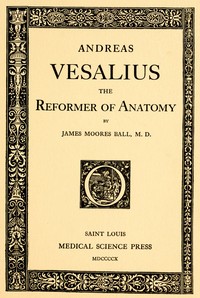
Andreas Vesalius, the Reformer of Anatomy by James Moores Ball
James Moores Ball's biography isn't just a dry list of dates. It's the story of a revolution that happened on the dissection table.
The Story
The book follows Andreas Vesalius from his student days in Paris, where he grew frustrated that professors would read from ancient texts while a barber did the messy work of dissection. Vesalius believed you had to get your hands dirty to learn the truth. He moved to Padua, Italy, and began a dangerous project: creating a complete, accurate atlas of human anatomy based entirely on his own observations. This meant secretly acquiring corpses, often from gallows or graveyards, which could have gotten him executed. His masterpiece, 'De humani corporis fabrica,' published when he was just 28, was a massive book filled with stunningly detailed illustrations. It directly challenged the authority of Galen, the ancient doctor whose teachings were treated as gospel. The book shows Vesalius's fight to make people see that the human body in front of them was more important than the ideas in a dusty old book.
Why You Should Read It
What grabbed me was how modern Vesalius feels. This isn't just about old medicine; it's about a mindset. He was the original skeptic, the guy who said, "Show me the evidence." Ball makes you feel the tension of his work—the cold rooms, the fear of discovery, the thrill of a new discovery in the muscles of a hand. You see Vesalius not as a marble statue of a Great Man, but as a passionate, sometimes arrogant, and relentlessly curious young person who changed the world by insisting on looking for himself. It’s a powerful reminder that big changes often start with someone asking a simple question: "Is that actually true?"
Final Verdict
Perfect for history buffs who like stories of scientific discovery, or anyone who enjoys a good biography about a misunderstood genius. It's also great if you're curious about medicine but don't want a technical textbook. Ball writes with clear admiration for his subject, but doesn't ignore the darker, grittier side of 16th-century science. You'll come away with a new appreciation for every medical diagram you've ever seen and the courage it took to make the first one right.
This book is widely considered to be in the public domain. Preserving history for future generations.
Charles Brown
8 months agoThe citations provided are a goldmine for further academic study.
Barbara Jones
1 year agoI've been looking for a reliable source on this topic, and the concise summaries at the end of each section are a lifesaver. I'm glad I chose this over the other alternatives.
Margaret Brown
8 months agoImpressive quality for a digital edition.
Andrew Nguyen
2 years agoGood quality content.









Matthew Davis
7 months agoI decided to give this a try based on a colleague's recommendation, the author’s unique perspective adds a fresh layer to the discussion. It’s hard to find this much value in a single source these days.