
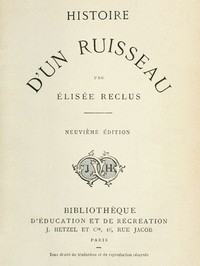
Histoire d'un ruisseau by Elisée Reclus
I picked up Histoire d'un ruisseau after a hiking trip where I stood over a stream and thought, 'This is everything and nothing.' In this book, Elisée Reclus proves that isn't just poetic nonsense. Written in 1869, it feels like a fever dream between Albert Camus and National Geographic—part nature walk and part meditation on the entire universe.
The Story
There's no plot with heroes and car chases. Instead, Reclus takes you by the hand and whispers, 'Watch this puddle here. See where it goes.' He puts a single stream under a microscope and then zooms out to a satellite view. You get the stream as a crying infant in a cave, trickling out of rock. Then it becomes a teenager spilling through a meadow, carving paths without asking permission. By the time he covers how it interacts with forests, the atmosphere, entire mountain ranges, and even human cities—it starts to feel like a biography of a god. The hidden conflict is between order (the world we try to make, with dams and laws) and wild, stubborn persistence (the stream just doing its thing). Reclus sneakily argues that the stream IS the real authority here—and we're just passengers for a few hundred miles. It is two hundred and fifty pages of falling water talking about freedom, and it works.
Why You Should Read It
This book doesn't stay in the dirt. After 100 pages, you realize Reclus isn't just teaching you about erosion (but you WILL know a lot about that too). He's writing about movement as resistance. Every water droplet is a fugitive, escaping altitude, blending, resisting being stagnant. And in 2023, when we all feel pinned-down by alarm bells and grid layout, reading someone from more than a century ago say, 'Look—the water ignores your borders, your banks, your fences' wakes up something in your chest. The prose reads like a diary entry rather than bullet points—thank god. When you catch him discussing caravans, the shape of leaves in current, and police cells back to back—you know why he'd spend years as an exile. He published this as anarchist philosophy masks itself up as birdwatching. And yes, the ending: when drops reach the salty mouth of the sea and he whispers about their dissolution into everything—well, that gutted me. It doesn’t end in war or land; it ends in embrace. Geographically, of course.
Final Verdict
Perfect for: Walkers in gardens listening to noise; people nervous about airplane cabins; reluctant baby environmentalists; suburban parents having a quiet Sunday catastrophe ; ancient-library-cave-dwellers. Read this book if you are currently angry at concrete walls or lost interest feeling big! Do NOT start if you demand sexy booms of mortal time per line—because this is just eons dissolved here to brief damp puddle page scrapper knowledge—an afternoon riverfriend in your blind.
This text is dedicated to the public domain. It serves as a testament to our shared literary heritage.
Jessica Brown
2 months agoThis was exactly the kind of deep dive I was searching for, the emphasis on ethics and sustainability within the topic is commendable. Highly recommended for those seeking credible information.
Michael Lopez
1 year agoI particularly value the technical accuracy maintained throughout.
Paul White
3 weeks agoI was particularly interested in the case studies mentioned here, the argument presented in the middle section is particularly compelling. An excellent example of how quality digital books should be formatted.
Donald Perez
5 months agoIt took me a while to process the complex ideas here, but the practical checklists included are a great touch for real-world use. Finally, a source that prioritizes accuracy over hype.







Emily Harris
1 year agoFinally found a version that is easy on the eyes.