
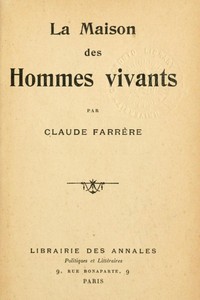
La maison des hommes vivants by Claude Farrère
Claude Farrère's La Maison des Hommes Vivants (The House of the Living Men) is a strange and captivating novel from 1911 that pulls you into a world most of us have never seen. It's a psychological drama wrapped in the exotic silks of the fading Ottoman Empire.
The Story
The story follows a young French attaché, fresh from Paris, who arrives in Constantinople. He's ambitious and confident in the superiority of his European ways. His mission is simple: navigate diplomacy and advance his career. But the city has other plans. He's introduced to a mysterious circle of Europeans known as the 'House of Living Men.' These men—diplomats, scholars, adventurers—have utterly rejected their Western lives. They speak Turkish, wear Ottoman dress, and have immersed themselves in local customs and spirituality.
Our narrator is both fascinated and disturbed by them, especially their enigmatic leader. As he is drawn deeper into their world, attending their gatherings in a secluded mansion, his own sense of identity begins to blur. The clear lines between East and West, between progress and tradition, start to melt away. The plot moves like a slow, hypnotic current, pulling him (and the reader) toward a profound personal crisis. Will he resist and cling to his old self, or will he surrender to the allure of this other life?
Why You Should Read It
This book got under my skin. It's not a thriller, but it's incredibly tense. Farrère builds an atmosphere so thick you can almost smell the incense and feel the humidity. The real magic is how he makes the city itself a character—a seductive, ancient force that challenges everything the hero believes.
The central question is brilliant: What is the cost of truly understanding another culture? Is it a beautiful transformation or a kind of treason against yourself? Farrère doesn't give easy answers. He shows the arrogance of the Western viewpoint but also the potential tragedy of losing your roots. The characters in the 'House' aren't portrayed as heroes or villains; they're complicated, lost souls searching for meaning in a place that feels more authentic to them than their homelands ever did.
Final Verdict
This is a book for a specific, but wonderful, kind of reader. It's perfect for anyone who loves atmospheric historical fiction where the setting is everything. Think of it as a companion to books like The Alexandria Quartet or the works of Joseph Conrad, but with a unique French-Ottoman twist. You need to be patient, because the payoff is a deep, lingering unease rather than a big plot twist. If you enjoy stories about cultural clash, identity, and the quiet drama of a man coming apart, La Maison des Hommes Vivants is a haunting and rewarding discovery from a forgotten corner of early 20th-century literature.
No rights are reserved for this publication. Enjoy reading and sharing without restrictions.
George Perez
1 year agoA brilliant read that I finished in one sitting.
Paul Moore
1 year agoThe analytical framework presented is both innovative and robust.
Karen Jackson
5 months agoI had low expectations initially, however the flow of the text seems very fluid. I couldn't put it down.
David Hernandez
1 year agoThe fonts used are very comfortable for long reading sessions.






Thomas Davis
10 months agoA must-have for graduate-level students in this discipline.