
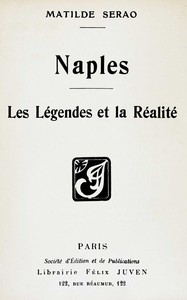
Naples : Les légendes et la réalité by Matilde Serao
Matilde Serao's Naples: Les légendes et la réalité (Naples: The Legends and the Reality) isn't a novel with a plot in the traditional sense. Think of it as a guided tour through the heart and gut of a city, led by its most sharp-eyed resident. Serao acts as our narrator, walking us through Naples in the late 19th century. She shows us the official version—the grand monuments, the celebrated history, the beautiful bay—and then immediately shows us what's happening in the shadows, in the homes, and on the faces of the people.
The Story
There's no single storyline. Instead, Serao builds a picture through scenes and observations. She contrasts the city's majestic churches with the intense, sometimes chaotic, faith of its people. She writes about the glittering Teatro San Carlo, then turns to the struggling families in the cramped quarters of the Spanish Quarters. She examines the legends of saints and miracles that are woven into the city's identity, holding them up against the hard, often gritty, reality of daily survival. The 'story' is the tension between the Naples of postcards and song, and the Naples of sweat, passion, and struggle.
Why You Should Read It
You should read this because Serao's voice is unforgettable. She isn't a detached observer; she's in the thick of it. Her writing is full of emotion—frustration, admiration, despair, and a deep, complicated love. She makes you feel the city's energy and its weight. Reading this, you understand that a place isn't just its buildings or its history; it's the spirit of its people. Serao captures that spirit in all its messy glory. She gives a voice to those often left out of the history books: the women, the poor, the everyday Neapolitans. It’s journalism, social commentary, and a love letter, all blended together.
Final Verdict
This book is perfect for travelers who want to go deeper than a guidebook, for anyone fascinated by how a city's character is formed, and for readers who enjoy strong, opinionated narrative voices. If you liked the immersive feel of Elena Ferrante's Neapolitan novels, Serao offers the real-life, journalistic foundation that that world is built upon. It's not always a comfortable read—Serao doesn't shy away from poverty or injustice—but it's a profoundly honest and moving one. You'll finish it feeling like you've truly met Naples, in all its magnificent, troubling complexity.
This work has been identified as being free of known copyright restrictions. Thank you for supporting open literature.
Matthew Torres
1 year agoI stumbled upon this title and the narrative structure is incredibly compelling. Thanks for sharing this review.
Barbara Jones
1 year agoI was skeptical at first, but the content flows smoothly from one chapter to the next. A true masterpiece.
David Anderson
8 months agoWow.
Nancy Sanchez
1 year agoFinally found time to read this!









Mary Miller
10 months agoThe clarity of the introduction set high expectations, and the transition between theoretical knowledge and practical application is seamless. A trustworthy resource that I'll keep in my digital library.