
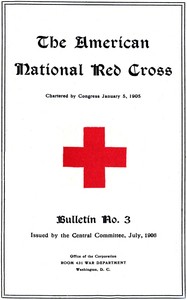
The American National Red Cross Bulletin (Vol. I, No. 3, July 1906)
Let's be clear: this isn't a novel. The American National Red Cross Bulletin from July 1906 is a primary source document, a collection of reports and correspondence published in the immediate aftermath of the San Francisco earthquake. But don't let that scare you off—it reads with a gripping, almost frantic energy.
The Story
The 'story' is the real-life crisis and response. The bulletin is essentially the Red Cross's own after-action report, compiled while the dust was still settling. It starts with the first confused telegrams reaching Washington, D.C., and follows the unfolding effort. You get lists of supplies shipped (think blankets, not bandaids), detailed accounts of setting up refugee camps in city parks, and the grim logistics of feeding tens of thousands of suddenly homeless people. There are notes on medical challenges, like preventing disease in crowded tent cities, and the complicated task of distributing donations fairly. The narrative is built from memos, financial statements, and field updates, creating a mosaic of a society trying to put itself back together.
Why You Should Read It
I loved this because it strips away the legend and shows the messy, hard work of disaster relief. You see the arguments over how to use funds and the sheer scale of the need. It's oddly personal—you're reading the actual words of people making impossible decisions. There's no Hollywood heroics, just the grinding, essential work of providing clean water and a safe place to sleep. It gives you a huge respect for the sheer organizational will it took. More than that, it connects you directly to a moment in history. You feel the urgency in every line. It makes history tangible in a way a textbook summary never could.
Final Verdict
This is perfect for anyone who loves real history, especially stories of resilience and community. If you're interested in emergency management, sociology, or just incredible human stories, you'll find it here. It's also a great, quick read for anyone who thinks primary sources are boring—this one will change your mind. Approach it like you're reading a journal from the front lines of a crisis, and you'll be completely pulled in.
This publication is available for unrestricted use. Access is open to everyone around the world.
Barbara Martinez
4 months agoImpressive quality for a digital edition.
Patricia Taylor
6 months agoAs someone who reads a lot, it provides a comprehensive overview perfect for everyone. Definitely a 5-star read.
William Smith
7 months agoAfter hearing about this author multiple times, it provides a comprehensive overview perfect for everyone. A true masterpiece.
Logan Johnson
2 months agoFrom the very first page, it challenges the reader's perspective in an intellectual way. I couldn't put it down.



Thomas Taylor
11 months agoIt took me a while to process the complex ideas here, but the transition between theoretical knowledge and practical application is seamless. A perfect balance of theory and practical advice.