
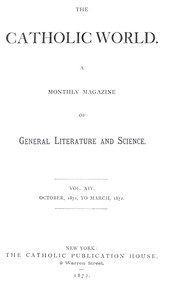
The Catholic World, Vol. 14, October 1871-March 1872 by Various
Let's be clear: this isn't a novel. The Catholic World, Vol. 14 is a six-month collection of a monthly periodical. There's no single plot. Instead, it's a mosaic of voices from a specific, turbulent time. The year 1871 was a watershed. The First Vatican Council had recently concluded, firmly establishing papal infallibility as doctrine. Simultaneously, the political unification of Italy stripped the Pope of his temporal lands, leaving him a 'prisoner in the Vatican.' This book is the sound of a community reacting, thinking, and wrestling with those twin shocks.
The Story
There is no traditional narrative. You open the pages and find yourself in a room where everyone is talking at once. One essay fiercely defends the Church's intellectual tradition against rising secularism. A piece of serialized fiction might offer a moral tale about faith and hardship. A historical analysis examines the early Church fathers. A correspondent reports on the condition of Catholics in Germany or America. The 'story' is the lived experience of a global faith in a period of profound crisis and change. You're reading the thoughts they were publishing for each other as events unfolded.
Why You Should Read It
I loved this for its raw immediacy. History books tell you what happened. This shows you how it felt while it was happening. You see the anxiety, the defiance, the scholarly arguments, and the attempts to find comfort. It removes the filter of hindsight. These writers didn't know how things would turn out. Their certainty and their fears are right there on the page. It's also surprisingly diverse in topic—you'll jump from theology to a book review to a poem, which keeps it fresh. Reading it feels less like studying and more like eavesdropping on a pivotal year.
Final Verdict
This is a niche but rewarding read. It's perfect for history buffs, especially those interested in 19th-century Europe, religious history, or the history of ideas. If you enjoy primary sources and want to understand the mood of the Catholic Church at a critical juncture, there's nothing better. It's probably not for someone looking for a light narrative or a unified argument. But if you like the idea of exploring a moment in time through the original words of the people who lived it, this volume is a direct line back to 1871. Approach it like a documentary in text form, and you'll be fascinated.
No rights are reserved for this publication. Distribute this work to help spread literacy.
Mary Hill
5 months agoVery helpful, thanks.
Logan Flores
11 months agoCompatible with my e-reader, thanks.





Matthew Ramirez
9 months agoHonestly, the character development leaves a lasting impact. A valuable addition to my collection.