About 114 minutes
History of the Revolt of the Netherlands — Volume 02 — Themes and Context
World Events
26,214 recorded words. 10 minutes difference from this book's estimate.
View Gutenberg source #6777
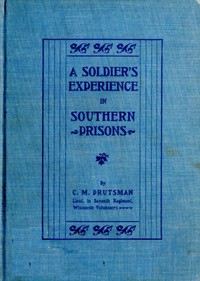
This digital edition of A Soldier's Experience in Southern Prisons A Graphic Description of the Author's Experiences in Various Southern Prisons — Themes and Context is described by source-level measurements including 23,738 words, 1 hr 44 min estimated reading time, and 3 detected text sections.
The text analysis averages about 25.7 words per sentence, while the detected sections provide another way to judge how the source is divided.
Project Gutenberg metadata also associates the work with “United States -- History -- Civil War, 1861-1865 -- Prisoners and prisons,” connecting these edition facts with the source record’s subject description.
Explore this collection
These alternatives are selected using recorded categories and estimated reading time.
About 114 minutes
World Events
26,214 recorded words. 10 minutes difference from this book's estimate.
View Gutenberg source #6777About 88 minutes
World Events
20,176 recorded words. 16 minutes difference from this book's estimate.
View Gutenberg source #6778About 121 minutes
World Events
27,697 recorded words. 17 minutes difference from this book's estimate.
View Gutenberg source #15520Search stored excerpts and compare books → Choose by your preferences →
Choices use stored catalog measurements. Estimates vary with reading speed. A shared category is a catalog label, not a claim that two books have the same argument or literary quality.
Search reads excerpt text stored with this catalog and links to its associated Gutenberg record. The connection is stored in the site database; this tool does not recheck that every excerpt is word-for-word identical to that external record. Excerpt search does not cover every chapter and does not verify historical publication dates.
Catalog snapshot checked: 2026-09-26. Coverage: 100 public books, 100 available source excerpts.
Calculated from edition completeness, EPUB availability, text structure and catalogue metadata. Not a user rating.
Total of 100 points, scaled to a 2.5-5.0 range. Editions with an empty description or a missing EPUB file are not scored.
Public-domain source text
The source text is kept in the dedicated reader, separate from this catalogue record and its commentary.
Christian Miller Prutsman, a lieutenant in the Seventh Wisconsin Volunteers, published this account of his imprisonment in 1901, decades after the events. The narrative opens not with a battle but with a minor officer's mistake: a major's folly leads to the capture of Prutsman's picket line. From there, the reader is plunged into a world where the author loses a valuable pair of boots—a small but telling detail that recurs as a symbol of deprivation. The catalog subjects list only "United States -- History -- Civil War, 1861-1865 -- Prisoners and prisons," but the excerpts reveal a more textured story, one that includes not just suffering but also moments of unexpected hospitality and even humor.
The excerpts show that Prutsman's memoir is built from concrete, sensory details rather than abstract commentary. The loss of his boots—first mentioned in the chapter title and then elaborated in the narrative—becomes a running motif. When he finally receives a meal at a farmhouse, the description is precise: "a bountiful breakfast" on a table, the first table he had sat down to in over a year. The author notes the clean, wholesome meal with a specificity that underscores its rarity. Such details ground the reader in the physical realities of captivity: hunger, cold, and the small comforts that become monumental.
Prutsman also records the speech of those he encounters. The lady of the house delivers a monologue on the Confederacy's decline, blaming "old 'Jeff' Davis" for impressing property and conscripting men. This is not a political treatise but a reported conversation, giving the reader a sense of the civilian mood in 1865. The author refrains from editorializing, letting the woman's words stand as evidence of Southern disillusionment.
The excerpts include a detailed account of an escape attempt from "Camp Sorghum." Prutsman travels fifty-six miles on foot, living on "corn on the ear and raw cow peas," before being recaptured. The journey is measured in miles and meals: two good square meals in three nights. After recapture, he is placed in a "debtor's cell" at Abbeville jail, where he finds six other escaped prisoners. The term "debtor's cell" hints at the legalistic framework of the Confederacy's prison system, but the author does not explain it; he simply reports his astonishment.
The narrative then shifts to a series of transfers: from Abbeville to Lexington County court house, then back to Columbia and "Camp Sorghum." The mode of transport varies—an old carry-all, then a stylish rig—but the destination is always the same. Prutsman's understated conclusion—"I found myself back again in the old quarters, in spite of my ducking"—conveys the futility of escape without melodrama. The reader is left to infer the psychological toll from the accumulation of such episodes.
One of the most striking passages in the excerpts describes a soldier who captures Prutsman but then treats him with unexpected courtesy. The soldier allows him the freedom of the house and yard on a verbal parole, and the family mends his torn clothing. Prutsman explicitly contrasts this treatment with the "false chivalry" he experienced elsewhere. The passage is notable for its restraint: the author does not generalize from this one instance, but instead presents it as an exception that proves a rule.
Yet even this hospitality is conditional. The soldier is still taking him to the provost marshal. The meal and the mended clothes do not change the fact of imprisonment. Prutsman's narrative thus complicates any simple dichotomy between Northern and Southern character. The catalog subject "Prisoners and prisons" suggests a focus on institutions, but the excerpts show that individual encounters—both cruel and kind—are equally central to the story. The reader is left to weigh these moments against the broader system of captivity.
Prutsman's memoir is best approached as a series of discrete episodes rather than a continuous narrative. The table of contents lists chapters with titles like "I lose a valuable pair of boots" and "Bloodhound steaks," signaling a focus on incident over analysis. Readers should attend to the small details—the boots, the meals, the modes of transport—that Prutsman uses to convey the texture of his experience. The catalog subjects provide a starting point, but the excerpts suggest that the book's value lies in its particularity, not its typicality.
Reading Prutsman's account of those Southern prisons, I kept thinking about the small kindnesses that flickered against the official cruelty. It reminded me of a regimental history I once leafed through, History of the Forty-second regiment infantry, Massachusetts volunteers, 1862, 1863, 1864 — Reading Notes, where the same quiet tension between orders and humanity seemed to linger between the lines.
Save your reaction, strongest insight, and memorable passage.