About 210 minutes
The Old Sixth Regiment, Its War Record, 1861-5 — Key Ideas to Explore
World Events
48,281 recorded words. 8 minutes difference from this book's estimate.
View Gutenberg source #50047
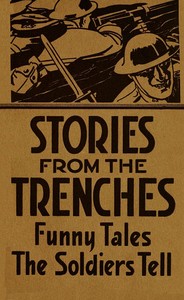
This digital edition of Stories from the trenches — Context and Discussion is described by source-level measurements including 46,306 words, 3 hr 22 min estimated reading time, and 28 detected text sections.
The text analysis averages about 20.5 words per sentence, while the detected sections provide another way to judge how the source is divided.
Project Gutenberg metadata also associates the work with “World War, 1914-1918 -- Anecdotes,” connecting these edition facts with the source record’s subject description.
Explore this collection
These alternatives are selected using recorded categories and estimated reading time.
About 210 minutes
World Events
48,281 recorded words. 8 minutes difference from this book's estimate.
View Gutenberg source #50047About 186 minutes
World Events
42,740 recorded words. 16 minutes difference from this book's estimate.
View Gutenberg source #57793About 221 minutes
World Events
50,690 recorded words. 19 minutes difference from this book's estimate.
View Gutenberg source #54203Search stored excerpts and compare books → Choose by your preferences →
Choices use stored catalog measurements. Estimates vary with reading speed. A shared category is a catalog label, not a claim that two books have the same argument or literary quality.
Search reads excerpt text stored with this catalog and links to its associated Gutenberg record. The connection is stored in the site database; this tool does not recheck that every excerpt is word-for-word identical to that external record. Excerpt search does not cover every chapter and does not verify historical publication dates.
Catalog snapshot checked: 2026-09-26. Coverage: 100 public books, 100 available source excerpts.
Calculated from edition completeness, EPUB availability, text structure and catalogue metadata. Not a user rating.
Total of 100 points, scaled to a 2.5-5.0 range. Editions with an empty description or a missing EPUB file are not scored.
Public-domain source text
The source text is kept in the dedicated reader, separate from this catalogue record and its commentary.
Carleton B. Case's Stories from the Trenches assembles anecdotes from World War I that rely heavily on reported dialogue and regional dialect to create immediacy. The collection opens with the redemption arc of Lieutenant-Colonel John F. Elkington, a story told through third-person summary and direct quotation from the New York Herald. This blending of journalistic sourcing with narrative framing recurs throughout, as Case often attributes tales to newspapers or official accounts, lending an air of authenticity while allowing him to shape the material for popular consumption.
Case frequently renders speech in nonstandard orthography to signal regional or class identity. In the story of the Kentucky father confronting his son, the father's lines are transcribed with dropped g's and colloquial contractions: “It ain’t like our folks to act as that youngster has acted.” The father’s threat to shoot his son “in the public square” is delivered in the same vernacular, reinforcing a stereotype of mountain justice. This technique appears in other sketches, where soldiers’ voices are similarly marked—Tommy Atkins is given a Cockney-inflected grin, and French characters speak accented English. The effect is to create a mosaic of voices, but the consistency of the dialect suggests a deliberate authorial choice to emphasize the diversity of the Allied forces.
Most pieces in the collection follow a compact structure: a brief setup, a central incident or exchange, and a punchline or moral. The anecdote about the medical examiner who passes an applicant for “imbecility” after learning he has a private income ends with the examiner’s verdict, “You are no imbecile. Passed for general service.” This reversal is typical—Case often withholds the ironic twist until the final line. Longer narratives, like the Elkington story, use a more conventional arc (disgrace, redemption, honor), but even these are condensed into a few paragraphs. The table of contents lists 28 sections, many under two pages, indicating that brevity and rapid payoff are central to the book’s design.
Case frequently attributes dialogue or facts to named sources, such as “the New York Herald” or “The Times.” In the Elkington account, he writes “says the New York Herald” before quoting the list of medals. This practice creates a documentary veneer, but the quoted speech is often too neat to be verbatim—the Kentucky father’s long, rhythmic monologue, for instance, reads as a composite. Case also uses indirect discourse to summarize events, then shifts to direct quotation for emotional peaks. The effect is a hybrid of journalism and storytelling, where the authorial hand is visible in the selection and compression of material.
Several anecdotes revolve around the restoration of honor after disgrace. Elkington’s reinstatement is described as “a bit of paper which obliterates the errors of the past.” The Kentucky father insists his son “find the trail again” or face execution. These stories share a vocabulary of shame (“quitter,” “slacker,” “backslider”) and redemption (“redeem himself,” “come to time”). Case does not dwell on the horrors of war; instead, he focuses on moral tests and their outcomes. The collection’s subtitle, “Humorous and Lively Doings,” signals that the tone is predominantly light, but the undercurrent of disgrace and recovery suggests a deeper concern with maintaining morale and social order.
Readers approaching Stories from the Trenches should attend to how Case mediates between reported fact and narrative convenience. The anecdotes are best read as period artifacts that reveal how wartime editors shaped public perception. The dialect, the rapid pacing, and the reliance on official sources all contribute to a portrait of the war as a series of manageable, often comic episodes—a deliberate contrast to the chaos of the trenches themselves.
This note on Case’s dialect and soldier humor took me back to my grandfather’s clipped letters from France, how he never said “trench” without a pause. Later, The War Stories of Private Thomas Atkins — A Closer Reading gave me that same quiet ache—the way reported speech holds a man’s voice just out of reach, bravely ordinary.
Answer a few questions and save a private reflection on this device.