About 78 minutes
Escape from East Tennessee to the federal lines — Story, Setting & Ideas
Modern Nations
17,724 recorded words. 1 minutes difference from this book's estimate.
View Gutenberg source #70992
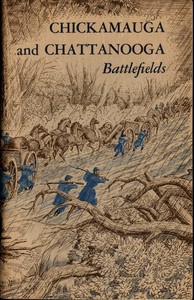
This digital edition of Chickamauga and Chattanooga Battlefields Chickamauga and Chattanooga National Military Park—Georgia, Tennessee — A Reader’s Guide is described by source-level measurements including 17,564 words, 1 hr 17 min estimated reading time, and 3 detected text sections.
The text analysis averages about 16.2 words per sentence, while the detected sections provide another way to judge how the source is divided.
Project Gutenberg metadata also associates the work with “United States -- History -- Civil War, 1861-1865,” connecting these edition facts with the source record’s subject description.
Explore this collection
These alternatives are selected using recorded categories and estimated reading time.
About 78 minutes
Modern Nations
17,724 recorded words. 1 minutes difference from this book's estimate.
View Gutenberg source #70992About 74 minutes
Modern Nations
16,903 recorded words. 3 minutes difference from this book's estimate.
View Gutenberg source #4055About 73 minutes
Modern Nations
16,615 recorded words. 4 minutes difference from this book's estimate.
View Gutenberg source #4805Search stored excerpts and compare books → Choose by your preferences →
Choices use stored catalog measurements. Estimates vary with reading speed. A shared category is a catalog label, not a claim that two books have the same argument or literary quality.
Search reads excerpt text stored with this catalog and links to its associated Gutenberg record. The connection is stored in the site database; this tool does not recheck that every excerpt is word-for-word identical to that external record. Excerpt search does not cover every chapter and does not verify historical publication dates.
Catalog snapshot checked: 2026-09-26. Coverage: 100 public books, 100 available source excerpts.
Calculated from edition completeness, EPUB availability, text structure and catalogue metadata. Not a user rating.
Total of 100 points, scaled to a 2.5-5.0 range. Editions with an empty description or a missing EPUB file are not scored.
Public-domain source text
The source text is kept in the dedicated reader, separate from this catalogue record and its commentary.
This 1956 National Park Service handbook, part of the Historical Handbook Series (Number 25), treats the Chickamauga and Chattanooga campaigns as a single operational story. The catalog subject 'United States -- History -- Civil War, 1861-1865' is accurate but broad: the text covers only the autumn of 1863, from the Tullahoma Campaign through the relief of Knoxville. The 'military-war' secondary topic fits, but the handbook's dual function—battle narrative and park guide—is not reflected in the catalog. The excerpts show a voice that is official, concise, and focused on unit movements, terrain, and logistics, with little attention to individual soldiers or broader political context.
The handbook's language is consistently impersonal and procedural. Phrases such as 'the pontoon-borne troops quickly disembarked' and 'the way was finally clear for the Union Army' emphasize execution over emotion. The text is organized as a chronological campaign narrative followed by a 'Guide to the Area' with sub-sections for Chickamauga Battlefield, Missionary Ridge, and Point Park. This structure reveals the handbook's dual purpose: to inform visitors and to commemorate. The catalog subjects do not capture this hybrid nature, treating the work as a straightforward history rather than a site-specific interpretive document.
The excerpts devote unusual attention to supply lines and engineering. The 'Cracker Line'—a route combining river transport, pontoon bridges, and mountain roads—is described in precise geographic terms: 'Above Kelley’s Ferry, the swift current made the stream unnavigable at certain points.' Similarly, the seizure of Brown’s Ferry is presented as a coordinated river-and-land operation. This focus on logistics, rather than combat heroics, aligns with the National Park Service's educational mission but is not evident from the catalog's broad subject headings. The text treats the movement of horses, mules, and pontoon bridges as critical to the campaign's outcome.
Geographic features—Raccoon Mountain, Lookout Valley, Moccasin Point, Missionary Ridge—are named repeatedly and function almost as actors. The handbook explains how terrain constrained movement: 'the swift current made the stream unnavigable at certain points to boats then available.' It also describes how commanders used terrain for concealment, as when Sherman's troops marched 'behind Stringer’s Ridge, concealed from the eyes of the Confederates.' This emphasis on physical landscape is typical of military park handbooks but is not signaled by the catalog subjects, which list only the park's name and the Civil War as a whole.
Readers should approach this handbook as a period document—a 1950s National Park Service publication with a specific institutional voice. Its value lies not in original research but in its synthesis of military events for a visiting public. The catalog subjects understate the work's practical orientation: it is as much a guidebook as a history. Comparing the narrative sections with the 'Guide to the Area' reveals how the Park Service chose to frame the battlefield experience for mid-century Americans.
This old handbook lingers on maps drawn for soldiers, not tourists, tracing Chattanooga’s ridges as if memorizing a face. I think sometimes of Champlain, another quiet record of ground claimed by will and weather. Both speak of rivers and stubborn hope, the past held tenderly in plain words. The Founder of New France : A Chronicle of Champlain — A Closer Reading sits nearby, a companion in patience.
Save your reaction, strongest insight, and memorable passage.