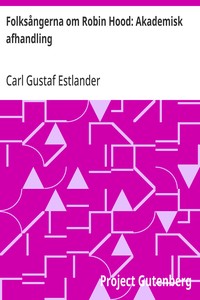
Folksångerna om Robin Hood: Akademisk afhandling by Carl Gustaf Estlander
Let me tell you about this seriously peculiar book that I found while browsing the dusty corners of the internet. It’s called "Folksångerna om Robin Hood" ("The Folk Songs about Robin Hood") by Carl Gustaf Estlander, written way back in the 1860s. I bet you didn't guess that Robin Hood once got the "academic dissertation" treatment!
The Story
Think of this not as the story of Robin Hood, but the story behind the stories of Robin Hood. Estlander wasn’t a screenwriter; he was like a historian-detective. In the 1800s, he noticed that no one really knew if the old Robin Hood ballads were poetry, history, or just campfire lies.
So he went looking. He looked at which songs came first, which towns influenced the plot, and whether the Merry Men had names that meant something ancient. The book traces how these folksongs traveled from village to village, bouncing and changing like old whispers. The “action” is him hunting down these fragile words printed in blackletter or simple manuscripts, treating each ballad like a clue stone. By the last few pages, you feel like you’ve read a mystery novel—about a myth.
Why You Should Read It
For a book over 150 years old, Estlander’s voice actually buzzes with excitement. He starts small—just talking about a line in a 15th-century poem—and then he leaps to connect it to his own time, asking big questions about why we keep retelling these outlaw tales. I loved that he focuses on the grit: not palace ballrooms, but cursed forests and cheap beer. There’s a personal rawness to it, like how, even back then, people wanted Robin Hood to punch corrupt royalty—still relevant!
And stick with me here: although this is heavy on Swedish academic words and *very* old quotes, it lacks any fancy intellectual bullying. Estlander imagines Robin Hood tired, legendary as bandit, yet strangely human.
Final Verdict
Don’t bring this expecting flying arrows or a blockbuster plot. Bring it if you love weird cultural detective work. If you recommend it to a friend, say it’s like an ancestor of a history podcast—long moments of quiet digging. Perfect for history buffs who enjoy worn leather jackets and “But where did your favorite story REALLY begin” obsessives. Not for everyone? Yes. For some lonely nerd who gets emotional reading ancient margined notes? Yes, definitely.
This work has been identified as being free of known copyright restrictions. Access is open to everyone around the world.