
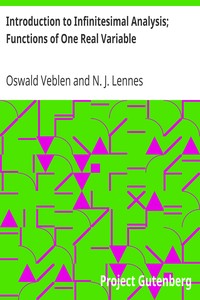
Introduction to Infinitesimal Analysis; Functions of One Real Variable by Veblen et al.
Let's be clear: this is not a beach read. Introduction to Infinitesimal Analysis is a technical mathematics textbook from the early 20th century. But its 'plot' is one of the most important intellectual stories of the modern era.
The Story
Imagine inventing a super-powerful tool—like calculus—that lets you solve previously impossible problems in physics and engineering. But there's a catch: the core idea your tool is based on is logically flawed. That was the state of calculus for nearly 200 years. Mathematicians used 'infinitesimals,' ghostly numbers infinitely close to zero, to make their calculations work, but couldn't properly define them. This book is part of the final act in a long drama to fix that. Authors like Veblen and Lennes didn't invent the solutions (credit largely goes to earlier figures like Weierstrass and Dedekind), but they were key educators who helped codify and teach the new, rigorous foundation. The 'story' here is the step-by-step construction of real analysis, building the concepts of limits, continuity, and derivatives without any magical, infinitely small quantities.
Why You Should Read It
You won't read this for character development or plot twists. You read it to witness a paradigm being built, brick by logical brick. There's a certain beauty in seeing messy, intuitive ideas get a precise, formal makeover. It's like watching engineers reinforce a beloved but rickety old bridge with steel and concrete, preserving its function while making it safe for the future. For anyone who has slogged through a modern calculus course, seeing the 'why' behind all those epsilon-delta proofs is incredibly satisfying. This book shows the blueprint. It turns the dry exercises of a math class into chapters in a larger story about human understanding.
Final Verdict
This is a niche read, but a rewarding one. It's perfect for students of math or the history of science who want to understand the 'classical' presentation of analysis that dominated much of the 20th century. It's also great for curious lifelong learners with some calculus background who want to see how the sausage is made—how intuition is translated into unshakable logic. If you're looking for a narrative history, look elsewhere. But if you want to sit at the drafting table with the architects of modern mathematics, this is your invitation.
This is a copyright-free edition. Share knowledge freely with the world.
John Scott
5 months agoAfter hearing about this author multiple times, the emotional weight of the story is balanced perfectly. Highly recommended.
Ava Walker
6 months agoLoved it.



Barbara Rodriguez
1 year agoPerfect.