About 355 minutes
What Happened to Me — Context and Discussion
World Events
81,488 recorded words. 2 minutes difference from this book's estimate.
View Gutenberg source #50001
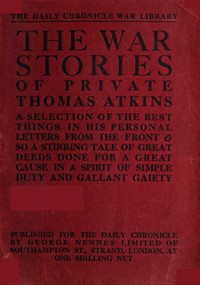
The source record for The War Stories of Private Thomas Atkins — A Closer Reading measures this digital text at 81,966 words, 5 hr 57 min estimated reading time, and 9 detected text sections.
The text analysis averages about 19.3 words per sentence, while the detected sections provide another way to judge how the source is divided.
Project Gutenberg metadata also associates the work with “World War, 1914-1918 -- Anecdotes,” connecting these edition facts with the source record’s subject description.
Explore this collection
These alternatives are selected using recorded categories and estimated reading time.
About 355 minutes
World Events
81,488 recorded words. 2 minutes difference from this book's estimate.
View Gutenberg source #50001About 377 minutes
World Events
86,549 recorded words. 20 minutes difference from this book's estimate.
View Gutenberg source #12429About 385 minutes
World Events
88,520 recorded words. 28 minutes difference from this book's estimate.
View Gutenberg source #58632Search stored excerpts and compare books → Choose by your preferences →
Choices use stored catalog measurements. Estimates vary with reading speed. A shared category is a catalog label, not a claim that two books have the same argument or literary quality.
Search reads excerpt text stored with this catalog and links to its associated Gutenberg record. The connection is stored in the site database; this tool does not recheck that every excerpt is word-for-word identical to that external record. Excerpt search does not cover every chapter and does not verify historical publication dates.
Catalog snapshot checked: 2026-09-26. Coverage: 100 public books, 100 available source excerpts.
Calculated from edition completeness, EPUB availability, text structure and catalogue metadata. Not a user rating.
Total of 100 points, scaled to a 2.5-5.0 range. Editions with an empty description or a missing EPUB file are not scored.
Public-domain source text
The source text is kept in the dedicated reader, separate from this catalogue record and its commentary.
The book opens not with a historian's overview but with the editor's direct address to "dear Private Atkins," praising his letters as "worthy to be bound in cloth of gold." Milne immediately establishes the collection's raw, personal tone by quoting soldiers' own phrases: "The hottest thing in South Africa was frost-bitten compared with what's going on here." The marching song "It's a Long Way to Tipperary" and the rallying cry "Are we downhearted?" serve as refrains, framing the narrative as one of resilience and dark humor.
The excerpts show a deliberate structure: each chapter groups short, attributed anecdotes from named privates (e.g., Pte. A. Wilson, Pte. T. Ball), preserving the immediacy of individual testimony. The editor's voice appears only in the opening and closing sections, letting the soldiers speak for themselves.
The early pages establish a distinctive blend of bravado and grim reality. Milne's introduction celebrates the soldier's natural storytelling: "You do get the red, living phrases, don't you, Private Atkins?" He quotes a soldier comparing the Boer War to "a mothers' meeting" beside the current conflict, and another describing a German's face "like a letter-box." These snippets signal that the book values vernacular wit over polished prose.
The table of contents reveals a thematic arc: from "Marching to War" and "The Friendly French" through "Battles in Being" and "How It Feels Under Fire" to "Stories of Sacrifice" and "Summing It Up." This progression suggests a narrative journey from anticipation to combat to reflection, though the excerpts only cover the middle chapters.
The middle excerpts plunge into close-quarters fighting. A Guardsman at Mons recounts a night patrol where German officers "seized the muzzles of the front-rank rifles a second before we had the order 'Fire!'" The result is a "proper mêlée" with slashing and volleys. The language is concrete: "The gun was only 400 yards away, and was blazing shrapnel into us. Five times we silenced it." Another soldier describes fixing bayonets: "It put you in mind of tossing hay, only we had human bodies." These accounts avoid abstraction, focusing on physical sensations—a ricochet bullet in the knee dug out with a knife, a rifle stopping a bullet to save a life.
The editor's framing is minimal; the soldiers' reports stand as unvarnished testimony. The cumulative effect is a mosaic of small, intense moments rather than a strategic overview.
Amid the violence, the excerpts repeatedly highlight the soldiers' morale and dark humor. A wounded Marine, face "deathly white," calls out "Are we downhearted?" and receives a hearty "No!" that drowns the cannon. The colonel of the Connaught Rangers rallies his men with a theatrical threat: "If you don't [charge them], never face me in this world nor in the next." The soldiers respond like "schoolboys at a treat" when ordered to fix bayonets.
Even in defeat or injury, the tone remains defiant. A dying German soldier becomes "chummy" with a wounded British private, recognizing his own fate as "booked through." These moments of shared humanity and grim comedy—like the letter-box face—prevent the collection from becoming a mere catalogue of horrors.
James Milne, identified as the author on the title page, acts as curator rather than narrator. His introduction and the epigraphs from Shakespeare, Browning, Tennyson, and Kipling provide a literary frame, but the body of the work consists entirely of soldiers' own words, each anecdote credited to a named private and his regiment. The table of contents shows twenty chapters, suggesting a comprehensive thematic organization.
The excerpts do not reveal the full scope of the book—only chapters I through XI are partially represented—but the pattern is clear: short, vivid vignettes grouped by topic, from "Marching to War" to "In the Trenches." The editor's voice returns only in the final chapter, "Summing It Up," which is not excerpted here. This structure prioritizes authenticity over authorial interpretation.
Readers approaching The War Stories of Private Thomas Atkins should expect a collage of firsthand accounts rather than a continuous narrative. The book rewards attention to the named soldiers and their specific regiments, as each anecdote carries the weight of individual experience. The editor's framing is light, so the reader must infer larger patterns from the juxtaposition of humor and horror. The collection is best read in short bursts, letting each soldier's voice stand alone.
Reading the soldiers’ letters in War Stories, I remembered my grandfather’s old Bible, his name penciled inside like an afterthought. There’s a similar quiet ache in leafing through the History of the Forty-second regiment infantry, Massachusetts volunteers, 1862, 1863, 1864 — Reading Notes, each muster roll a small door left ajar, letting in a breath of ordinary men who simply went, and stayed gone.
Answer a few questions and save a private reflection on this device.