About 281 minutes
Zone Policeman 88; a close range study of the Panama canal and its workers — Background and Themes
Modern Nations
64,528 recorded words. 3 minutes difference from this book's estimate.
View Gutenberg source #4786
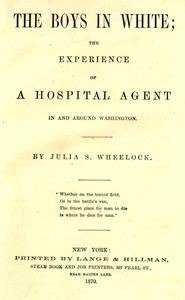
The boys in white — Story, Setting & Ideas can be approached with a clearer sense of reading commitment from its source measurements: 63,811 words, 4 hr 38 min estimated reading time, and 22 detected text sections.
The text analysis averages about 22.1 words per sentence, while the detected sections provide another way to judge how the source is divided.
Project Gutenberg metadata also associates the work with “United States -- History -- Civil War, 1861-1865 -- Hospitals,” connecting these edition facts with the source record’s subject description.
Explore this collection
These alternatives are selected using recorded categories and estimated reading time.
About 281 minutes
Modern Nations
64,528 recorded words. 3 minutes difference from this book's estimate.
View Gutenberg source #4786About 268 minutes
Modern Nations
61,417 recorded words. 10 minutes difference from this book's estimate.
View Gutenberg source #3157About 266 minutes
Modern Nations
61,165 recorded words. 12 minutes difference from this book's estimate.
View Gutenberg source #2724Search stored excerpts and compare books → Choose by your preferences →
Choices use stored catalog measurements. Estimates vary with reading speed. A shared category is a catalog label, not a claim that two books have the same argument or literary quality.
Search reads excerpt text stored with this catalog and links to its associated Gutenberg record. The connection is stored in the site database; this tool does not recheck that every excerpt is word-for-word identical to that external record. Excerpt search does not cover every chapter and does not verify historical publication dates.
Catalog snapshot checked: 2026-09-26. Coverage: 100 public books, 100 available source excerpts.
Calculated from edition completeness, EPUB availability, text structure and catalogue metadata. Not a user rating.
Total of 100 points, scaled to a 2.5-5.0 range. Editions with an empty description or a missing EPUB file are not scored.
Public-domain source text
The source text is kept in the dedicated reader, separate from this catalogue record and its commentary.
Julia S. Wheelock’s The Boys in White opens with a preface that establishes the book’s origin in a journal kept under extreme conditions: “much of it was written late at night when so wearied by excessive labor, anxiety, and excitement, that I would not unfrequently fall asleep with the pen in my hand.” This admission shapes the reader’s expectation of a text that is both personal and fragmented, a record of fatigue as much as of events. The author’s stated purpose—to help care for a wounded brother who died before she arrived—gives the narrative a founding loss that colors her subsequent work. The voice is direct, often matter-of-fact, yet capable of sudden emotional intensity, as when she describes a mother learning she is “too late” to see her son alive.
The preface reveals that the journal was “kept for my personal benefit, and not for publication,” and that much of it was composed in makeshift conditions—sitting “upon a box or some rude bench,” holding the book on her lap. This origin explains the text’s uneven pacing: some entries are dense with logistical detail (barrels of goods, donations, names of contributors), while others pause for poignant scenes, such as the Christmas distribution where soldiers “like children, begging for a piece of ‘Christmas pie!’” The prose can shift abruptly from a list of supplies to a reflection on the hundreds who received nothing. Wheelock’s voice is that of a practical observer who records what she sees without embellishment, yet the strain of her work occasionally breaks through in a sharp detail or a sudden exclamation.
Wheelock’s narrative is punctuated by encounters that reveal the human cost of war. One of the most striking is the meeting with a mother on a boat who has just learned her son died before she could reach him: “They were just closing his coffin when she found him.” Wheelock describes her as “rocking to and fro, wringing her hands and sobbing aloud,” and notes that “no words of mine could afford her consolation.” Such scenes contrast with moments of unexpected generosity, like the Christmas gift of forty dollars from Michigan gentlemen in Washington, or the visit from Professor Holden, who places a five-dollar bill in her hand. These episodes show a network of support that is both personal and institutional, and Wheelock records them with a mix of gratitude and matter-of-factness.
The journal’s structure follows the rhythm of supply distribution: Wheelock receives barrels of goods from Brighton, Michigan, and Harbor Creek, Pennsylvania, and ten dollars in money. She travels to field hospitals at Brandy Station, where she is “set out in the mud with my goods, no one to meet me.” The narrative often moves from a specific act of giving to a broader observation about scarcity, as when the Christmas dinner for Clifburn proves insufficient: “there were hundreds who received nothing.” This pattern—a concrete event followed by a quiet acknowledgment of limits—gives the book a cumulative weight. Wheelock does not moralize; she simply records what was given and what was lacking, letting the disparity speak for itself.
Because The Boys in White is a condensed journal rather than a retrospective memoir, its narrative voice remains close to the moment of writing. Readers should pay attention to shifts in tone—from the brisk listing of supplies to the sudden intimacy of a grieving mother’s cry—as clues to the author’s state of mind. The book’s value lies not in a continuous story but in the accumulation of such moments, each one a fragment of a larger, unwritten history.
That rainy afternoon, I kept returning to Julia’s quiet noting of how scarcities redefined every kindness. Her world felt cramped and patient. Later, browsing a shelf, I found myself reaching for On the Trail of Grant and Lee — A Closer Reading, curious how different breaths of the same war might settle, less like ambition, more like weather.
Your answers remain private and are stored only in this browser.