About 27 minutes
The Wentworth Letter — Text and Context
Modern Nations
5,985 recorded words. 1 minutes difference from this book's estimate.
View Gutenberg source #6720
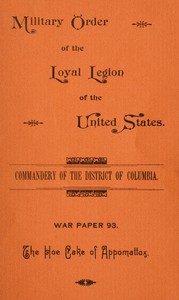
The catalog record for The hoe cake of Appomattox — Text and Context provides practical reading context through 6,325 words, 28 min estimated reading time, and 3 detected text sections.
The text analysis averages about 23.0 words per sentence, while the detected sections provide another way to judge how the source is divided.
Project Gutenberg metadata also associates the work with “United States -- History -- Civil War, 1861-1865 -- Personal narratives,” connecting these edition facts with the source record’s subject description.
Explore this collection
These alternatives are selected using recorded categories and estimated reading time.
About 27 minutes
Modern Nations
5,985 recorded words. 1 minutes difference from this book's estimate.
View Gutenberg source #6720About 54 minutes
Modern Nations
12,331 recorded words. 26 minutes difference from this book's estimate.
View Gutenberg source #58778About 55 minutes
Modern Nations
12,487 recorded words. 27 minutes difference from this book's estimate.
View Gutenberg source #2504Search stored excerpts and compare books → Choose by your preferences →
Choices use stored catalog measurements. Estimates vary with reading speed. A shared category is a catalog label, not a claim that two books have the same argument or literary quality.
Search reads excerpt text stored with this catalog and links to its associated Gutenberg record. The connection is stored in the site database; this tool does not recheck that every excerpt is word-for-word identical to that external record. Excerpt search does not cover every chapter and does not verify historical publication dates.
Catalog snapshot checked: 2026-09-26. Coverage: 100 public books, 100 available source excerpts.
Calculated from edition completeness, EPUB availability, text structure and catalogue metadata. Not a user rating.
Total of 100 points, scaled to a 2.5-5.0 range. Editions with an empty description or a missing EPUB file are not scored.
Public-domain source text
The source text is kept in the dedicated reader, separate from this catalogue record and its commentary.
Ellis Spear, a brevet brigadier-general, delivered this address to the Military Order of the Loyal Legion in 1913, reflecting on the physical and social conditions that forged Union soldiers' comradeship. Rather than recounting battles, he dwells on shared privations: common uniforms, outdoor living, and scarce food. The title refers to a hoe cake—a simple cornmeal bread—that becomes the focus of a moral anecdote. Spear's voice is wry and philosophical, blending military formality with personal confession.
Spear argues that the “subordinate conditions of a physical character” were as important as shared devotion in creating lifelong bonds. He catalogs these with dry humor: soldiers wore the same uniform for four years, slept on the ground, and ate from the “lap of mother earth.” The scarcity of soap and water made everyone look alike. He likens military training to a school where “Right face,” “Left face,” and “As you were” were the precepts. This leveling effect, he suggests, erased individuality and fostered equality. The description of the “spacious, well ventilated, scantily furnished and unroofed out-of-doors” as a common home underscores the irony of their shelter. Spear’s diction is precise yet conversational, turning hardship into a source of unity.
The central anecdote recounts a moment near Spotsylvania Court House when a brother officer lent Spear a canteen of soup. After a prolonged diet of “dirt, salt pork, fried or raw, and hardtack,” he faced a moral test: sharing the soup with an orderly. He claims to have divided it equally, “notwithstanding the disparity of rank.” The hoe cake itself appears later as a similar test. Spear writes that he “broke it on the square,” and this act became a touchstone for fairness in later life. The episode is presented as a “turning point” in his moral history, though he admits he may not always have lived up to it. The self-deprecating tone—calling it a “most confidential communication”—adds intimacy.
Spear’s description of eating the hoe cake is the most sensory passage. He speaks of “the ethereal sweetness of the Indian corn, a flavor as of sunshine and mother earth, of the neighborhood of oak and pine and sassafras and wild flowers.” This romanticized natural imagery contrasts with the earlier grimness. He notes that he “Fletcherized before Fletcher,” referring to the chewing fad of the era, and looked “regretfully on the last fragment.” The lesson he draws is that “the pleasure of eating depends more on the appetite than upon the diet.” This reflection ties physical hunger to a broader philosophy of satisfaction. The passage shows Spear’s ability to elevate a mundane detail into a meditation on human desire.
Spear’s prose oscillates between formal oratory and personal confession. He opens with grand statements about “the attraction of cohesion and the attraction of gravitation” in the political world, then shifts to the homely detail of a hoe cake. The address is structured as a series of contrasts: the abstract brotherhood versus concrete physical conditions; the moral high ground versus the “clamors of a beastly appetite.” His use of direct address—“you may properly also consider”—creates a sense of shared reflection. The piece is not a narrative of events but a thematic meditation, held together by the recurring image of the cake. Spear’s willingness to admit moral struggle, even while claiming success, gives the voice authenticity.
Readers should approach this text as a personal essay rather than a historical account. Spear’s focus on a single object—the hoe cake—allows him to explore memory, morality, and the physical realities of soldiering. The address rewards attention to its rhetorical shifts and self-deprecating humor. It offers a glimpse into how veterans of the Grand Army of the Republic framed their experience decades later, emphasizing shared humanity over martial glory.
I remember a crust of cornbread in that old Appomattox address—how such a meager thing bound men together through weariness and want. It makes me think of another volume, Some Cities and San Francisco, and Resurgam — Inside the Classic, where places themselves seem to share that same quiet insistence on memory, holding what we carry. Both, to me, whisper of endurance. Resurgam—rising again, one humble crumb at a time.
Answer a few questions and save a private reflection on this device.