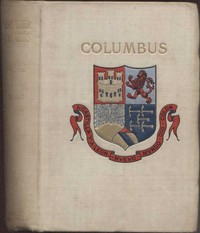
Christopher Columbus and the New World of His Discovery — Complete — Story, Setting & Ideas

(0 User reviews)   1373
In Category - Modern Nations
Young, Filson, 1876-1938 Project Gutenberg 2003 Not confirmed
Columbus, Christopher, 1451-1506; America -- Discovery and exploration Readers of public-domain and historical texts
Project Gutenberg digital edition en

Edition facts

Words 165,544
Reading time 720 min
Text sections 16

The source record for Christopher Columbus and the New World of His Discovery — Complete — Story, Setting & Ideas measures this digital text at 165,544 words, 12 hr estimated reading time, and 16 detected text sections.

The text analysis averages about 35.3 words per sentence, while the detected sections provide another way to judge how the source is divided.

Project Gutenberg metadata also associates the work with “Columbus, Christopher, 1451-1506,” connecting these edition facts with the source record’s subject description.

Explore this collection

Compare your next read

These alternatives are selected using recorded categories and estimated reading time.

Search stored excerpts and compare books → Choose by your preferences →

How these choices and excerpts are prepared

Choices use stored catalog measurements. Estimates vary with reading speed. A shared category is a catalog label, not a claim that two books have the same argument or literary quality.

Search reads excerpt text stored with this catalog and links to its associated Gutenberg record. The connection is stored in the site database; this tool does not recheck that every excerpt is word-for-word identical to that external record. Excerpt search does not cover every chapter and does not verify historical publication dates.

Catalog snapshot checked: 2026-09-26. Coverage: 100 public books, 100 available source excerpts.

Filson Young's 1906 narrative biography of Columbus, framed by a dedication to Sir Horace Plunkett that compares colonial administration in the New World to land reform in Ireland. The preface outlines a three-tier model of historical writing, and excerpts show Columbus's instructions on enslaving cannibals and hiring ships.
Share
Editorial Edition Score 4.9/5

Calculated from edition completeness, EPUB availability, text structure and catalogue metadata. Not a user rating.

How this score is calculated
  • Description quality20 pts
  • Title & short description10 pts
  • Source metadata20 pts
  • Text length15 pts
  • Chapters / structure15 pts
  • EPUB file integrity20 pts

Total of 100 points, scaled to a 2.5-5.0 range. Editions with an empty description or a missing EPUB file are not scored.

Edition quality

Public-domain source text

Read the source text

The source text is kept in the dedicated reader, separate from this catalogue record and its commentary.

Filson Young opens his 1906 narrative with a dedication to Sir Horace Plunkett that immediately signals an unusual lens: he compares Columbus's colonial administration in the New World to Plunkett's land reform work in Ireland, calling both efforts to "pour the wine of civilisation into very old bottles." The preface then outlines a three-tier model of historical writing—diggers, sowers, reapers—placing Young himself as the essayist who reaps the harvest. This self-conscious framing suggests the book is as much about the process of writing history as about Columbus.

A Dedication That Frames the Narrative

The book's dedication to Sir Horace Plunkett is not a mere courtesy; it establishes a governing metaphor. Young writes that Columbus's weakness as an administrator was thinking "the bottle was everything," while Plunkett cares for "the vintage." This comparison ties Columbus's New World ventures to contemporary Irish land policy, implying that the failures of colonial administration stem from neglecting human nature. The dedication also references a William Ires or Eyre from County Galway who "fertilised the soil he did it with his blood and bones," grounding the global story in a local Irish example. Readers should note that this framing may color the entire narrative, emphasizing administrative and economic themes over exploration.

The Preface's Historiographical Model

Young's preface explicitly describes historical biography as a partnership: "One group of historians, labouring in the obscurest depths, dig and prepare the ground... they are followed by those scholars and specialists... Last of all comes the essayist, or writer pure and simple, who reaps the harvest." This model positions Young as a synthesizer rather than an original researcher. The preface does not name his sources, but the metaphor suggests reliance on previous scholarship. The book's catalog subject—"America -- Discovery and exploration"—aligns with this secondary role. Young's narrative may therefore be more interpretive than documentary, a point to consider when evaluating its claims.

Evidence of Columbus's Instructions on Slavery

An excerpt from what appears to be Columbus's instructions includes detailed plans for enslaving "cannibals." The text describes them as "a very proud and comely people, well proportioned and of good intelligence" and proposes that they be taken to Spain as slaves, with payment for supplies made "in slaves from among these cannibals." A marginal note adds: "This project must be held in abeyance for the present until another method is suggested from there." The passage also discusses hiring caravels "by tons" and buying ships for security. This excerpt directly illustrates the administrative and economic concerns hinted at in the dedication, showing Columbus as a manager of logistics and human trafficking.

Young's book is not a straightforward chronicle of voyages but a narrative shaped by its author's interests in administration, economics, and historiography. The dedication and preface provide a lens through which to read the entire work, and the excerpts reveal Columbus as a figure deeply engaged in the mechanics of colonization, including slavery. Readers should attend to how Young's framing influences the portrayal of events and consider the book as a product of its 1906 context.

I finished that Columbus biography and kept thinking about how the same colonial logic appears in different places. It reminded me of reading The Philippines: Past and Present (Volume 1 of 2) — Themes and Context—that quiet weight of history repeating its justifications, the human cost tucked between policy lines. Both left me with a strange tenderness for the people caught in those plans, long after closing the pages.

There are no reviews for this eBook.

0
0 out of 5 (0 User reviews )

Add a Review

Your Rating *
There are no comments for this eBook.

Reader reflection

How will you remember this book?

Save your reaction, strongest insight, and memorable passage.

Your progress 0 / 10
1

Where are you in your reading?

2

Was reading this book enjoyable?

3

How likely are you to recommend this book?

4

How much effort did this book require?

Related eBooks