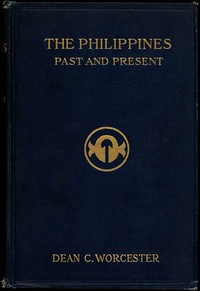
Dean C. Worcester, who served as Secretary of the Interior of the Philippine Islands from 1901 to 1913, structures this volume around a chronological and thematic examination of the transition from Spanish to American rule. The work opens with a frontispiece depicting General Emilio Aguinaldo standing beside a field of corn, an image Worcester uses to symbolize the peace and prosperity he attributes to American governance. This juxtaposition of a former insurgent leader with agricultural productivity recurs throughout the text as a visual and rhetorical device.
The volume moves from the question of whether independence was promised to the Filipinos, through detailed accounts of insurgent rule in various regions, and into the establishment of civil government, the constabulary, and public health initiatives. Worcester’s narrative is heavily documented with decrees, reports, and official correspondence, often reproducing the language of the documents themselves. The structure reflects a dual purpose: to justify American policy and to provide a record of administrative achievements.
Insurgent Government Decrees and Their Implications
Worcester devotes considerable attention to the decrees issued by Emilio Aguinaldo’s revolutionary government in June 1898. He reproduces the text of the decree of June 18, which established a system of town and provincial governments, and the decree of June 23, which proclaimed a revolutionary government with Aguinaldo as president. Worcester’s analysis emphasizes the centralization of power: the president could approve or reject elections, appoint representatives for provinces unable to elect them, and act unilaterally on urgent matters. He argues that despite the language of republicanism, the structure created a “highly centralized military dictatorship.” The excerpts show that the decree provided for four secretaries—foreign affairs, war, police and interior, and treasury—and a congress with advisory powers, but Worcester stresses that the president retained ultimate authority. This section illustrates how Worcester uses primary documents to support his critique of Filipino governance.
The Movement Between Manila and the Provinces
The narrative shifts frequently between the capital and outlying regions, reflecting Worcester’s concern with the reach of insurgent control. Chapter V examines the Wilcox-Sargent report on conditions in the Visayas, while Chapter VI focuses on the Cagayan Valley in northern Luzon. This geographic movement allows Worcester to argue that insurgent rule was inconsistent and often oppressive. He contrasts the situation in Manila, where American forces established order, with the provinces, where he claims chaos and abuse prevailed. The structure of the volume—moving from the question of independence to specific regional case studies—reinforces his argument that American intervention was necessary. The reader is taken from the halls of the revolutionary congress to the fields of Baguio, where the Benguet Road and government cottages are described as symbols of progress. This alternation between center and periphery is a deliberate rhetorical strategy.
Recurring Images of Infrastructure and Public Health
Throughout the volume, Worcester returns to images of infrastructure and health as evidence of American achievement. The list of illustrations includes photographs of artesian wells, improved streets, hospital wards, and the Benguet Road. In the text, he describes the construction of the road to Baguio, the establishment of the Culion Leper Colony, and the treatment of yaws with salvarsan. These details are not merely descriptive; they serve as counterpoints to his depictions of insurgent rule. For example, an unsanitary well is paired with a flowing artesian well, and an unimproved street in the Filipino quarter of Manila is contrasted with an improved street. This visual and textual pairing reinforces a narrative of progress. Worcester’s background as a scientist and administrator is evident in his attention to the coordination of scientific work, which he discusses in a dedicated chapter. The recurring focus on health and infrastructure ties the volume together as a record of colonial administration.
The Role of the Constabulary and the Administration of Justice
Worcester devotes separate chapters to the constabulary and the administration of justice, presenting them as pillars of American governance. He describes the constabulary as a force that brought public order, and the courts as institutions that replaced arbitrary rule. The excerpts from the table of contents show that these chapters are placed after discussions of civil service and before health conditions, suggesting a logical progression from establishing order to improving welfare. Worcester’s tone is factual, but his selection of evidence is partisan. He includes photographs of the Philippine Supreme Court and of Bilibid Prison, both presented as improvements over Spanish-era institutions. The chapter on the constabulary emphasizes its role in suppressing banditry and insurgent resistance, while the chapter on justice highlights the introduction of due process. These sections are among the most detailed in the volume, reflecting Worcester’s belief that legal and police reforms were essential to American rule.
Readers approaching this volume should be aware that Worcester writes from a position of authority as a former colonial official, and his account is both a historical record and a defense of American policy. The work is most useful when read alongside other sources, particularly Filipino perspectives on the same events. The detailed documentation of decrees and reports provides valuable primary material, but the interpretive framework is consistently pro-American. For those interested in the structure of colonial governance, the volume offers a systematic overview of how the United States sought to administer the Philippines, from the military campaigns of the Philippine-American War to the construction of roads and hospitals. The second volume continues the narrative into later developments.
I keep thinking about how Worcester’s account made me feel the weight of empire—how every decision, even well-meant ones, leaves marks on people and places. That ache reminded me of the quieter, lingering questions in France and England in North America, Part V: Count Frontenac, New France, Louis XIV — Edition Insights, where colonial ambition turns personal and strange. Both stay with you, softly unsettling, like a half-remembered conversation.