About 121 minutes
With Methuen's Column on an Ambulance Train — Edition Insights
World Events
27,697 recorded words. 1 minutes difference from this book's estimate.
View Gutenberg source #15520
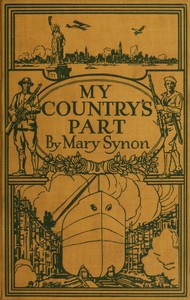
Before opening My country's part — Themes and Context, the edition data offers a quick orientation: 27,881 words, 2 hr 2 min estimated reading time, and 15 detected text sections.
The text analysis averages about 19.6 words per sentence, while the detected sections provide another way to judge how the source is divided.
Project Gutenberg metadata also associates the work with “World War, 1914-1918 -- United States,” connecting these edition facts with the source record’s subject description.
Explore this collection
These alternatives are selected using recorded categories and estimated reading time.
About 121 minutes
World Events
27,697 recorded words. 1 minutes difference from this book's estimate.
View Gutenberg source #15520About 129 minutes
World Events
29,550 recorded words. 7 minutes difference from this book's estimate.
View Gutenberg source #50519About 114 minutes
World Events
26,214 recorded words. 8 minutes difference from this book's estimate.
View Gutenberg source #6777Search stored excerpts and compare books → Choose by your preferences →
Choices use stored catalog measurements. Estimates vary with reading speed. A shared category is a catalog label, not a claim that two books have the same argument or literary quality.
Search reads excerpt text stored with this catalog and links to its associated Gutenberg record. The connection is stored in the site database; this tool does not recheck that every excerpt is word-for-word identical to that external record. Excerpt search does not cover every chapter and does not verify historical publication dates.
Catalog snapshot checked: 2026-09-26. Coverage: 100 public books, 100 available source excerpts.
Calculated from edition completeness, EPUB availability, text structure and catalogue metadata. Not a user rating.
Total of 100 points, scaled to a 2.5-5.0 range. Editions with an empty description or a missing EPUB file are not scored.
Public-domain source text
The source text is kept in the dedicated reader, separate from this catalogue record and its commentary.
Mary Synon's My Country's Part opens with a striking structural hybrid: a fictional chapter titled “My Grandmother and Myself” that introduces a boy named John Sutton, then shifts abruptly into a series of expository chapters on the United States and World War I. The book dedicates itself to three privates who were the first Americans to die in France, grounding its patriotic argument in specific sacrifice. Synon repeatedly contrasts American democracy with German autocracy, using the constitutional power to declare war as a key example: Congress debated, while the Kaiser thrust his country into war before the Reichstag knew officially. The text reproduces extended passages from President Wilson's April 2, 1917 war message, including the line “The world must be made safe for democracy,” treating the speech as a sacred document of national purpose.
The first chapter, “My Grandmother and Myself,” is the only explicitly fictional section in the excerpts. It introduces John Sutton returning from school to his grandmother, who watches at a basement window. The grandmother functions as a transmitter of patriotic memory, putting “the love of country” into John's soul through unnamed incidents. Synon writes that “the root of it is truth,” positioning the story as a pedagogical tool rather than pure invention. This framing device suggests the book was aimed at young readers, using a relatable protagonist to model the duty Synon later describes in abstract terms. The shift from narrative to exposition after Chapter I is abrupt, and the excerpts do not reveal whether the fictional thread returns. Readers should note that the grandmother's role as a guardian of national feeling echoes the book's broader argument that every American, regardless of origin, must hold “no divided allegiance.”
Synon devotes several chapters to explaining how the United States entered the war, emphasizing procedural legitimacy. She contrasts the American system—where Congress declares war—with German autocracy, noting that the Emperor committed the nation to war before the Reichstag knew. This constitutional argument is reinforced by a lengthy quotation from President Wilson's war message, which Synon presents as a defining moment. The excerpts include Wilson's call for “moderation of counsel” and his assertion that “the right is more precious than peace.” Synon frames the speech as a collective decision: “the voice of the man who was speaking not for himself but for our United States.” The text treats the message as both historical record and moral touchstone, using it to anchor the war in democratic deliberation rather than executive whim. Readers should observe how Synon weaves Wilson's words into her own prose, treating them as authoritative evidence.
The book's illustrations, listed in the front matter, form a visual argument about total mobilization. They range from “General Pershing's veterans direct from the trenches” marching in New York, to children selling thrift stamps and boys working in war gardens. The caption under Wilson's photograph reads: “On the second day of April, 1917 ... while a world waited breathlessly for the verdict of the great nation.” This pairing of text and image reinforces the idea that every American—soldier, child, immigrant—has a part. The illustration of “An immigrant family qualified to enter the United States” ties the war effort to national identity, suggesting that citizenship itself is a form of participation. The excerpts do not describe the images in detail, but the list indicates that Synon's argument is not only verbal but visual, using photography to document the home front as a site of patriotic action.
My Country's Part is best approached as a period document that blends genres: a civics lesson, a war justification, and a fictional primer. Readers interested in propaganda, home-front literature, or the rhetorical construction of American identity during World War I will find it a concentrated example. The excerpts suggest the book assumes a young audience, but its use of Wilson's speeches and constitutional analysis gives it a dual character. Because the excerpts are incomplete, the extent of the fictional frame and the treatment of dissent or complexity remain unclear. Treat the text as a snapshot of official patriotic discourse in 1918.
My grandmother’s copy of My Country’s Part still carries that earnest insistence on duty, the way it framed sacrifice as something almost domestic. Reading it lately, I kept thinking about the quiet lads in the other book, The War Stories of Private Thomas Atkins — A Closer Reading, who never spoke of causes, only of mud and letters from home. Both felt like holding the same frayed thread.
Build a private reading journal entry for this title.