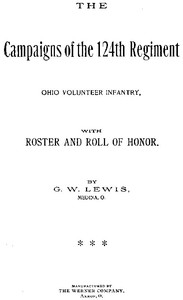
The Campaigns of the 124th Regiment, Ohio Volunteer Infantry, with Roster and Roll of Honor — Story, Setting & Ideas

(0 User reviews)   612
In Category - World Events
Lewis, G. W. (George W.), 1837- Project Gutenberg 2016 Not confirmed
United States -- History -- Civil War, 1861-1865 -- Regimental histories; United States. Army. Ohio Infantry Regiment, 124th (1862-1865) Readers of public-domain and historical texts
Project Gutenberg digital edition en

Edition facts

Words 71,071
Reading time 310 min
Text sections 20

The source record for The Campaigns of the 124th Regiment, Ohio Volunteer Infantry, with Roster and Roll of Honor — Story, Setting & Ideas measures this digital text at 71,071 words, 5 hr 10 min estimated reading time, and 20 detected text sections.

The text analysis averages about 10.2 words per sentence, while the detected sections provide another way to judge how the source is divided.

Project Gutenberg metadata also associates the work with “United States -- History -- Civil War, 1861-1865 -- Regimental histories,” connecting these edition facts with the source record’s subject description.

Explore this collection

Compare your next read

These alternatives are selected using recorded categories and estimated reading time.

Search stored excerpts and compare books → Choose by your preferences →

How these choices and excerpts are prepared

Choices use stored catalog measurements. Estimates vary with reading speed. A shared category is a catalog label, not a claim that two books have the same argument or literary quality.

Search reads excerpt text stored with this catalog and links to its associated Gutenberg record. The connection is stored in the site database; this tool does not recheck that every excerpt is word-for-word identical to that external record. Excerpt search does not cover every chapter and does not verify historical publication dates.

Catalog snapshot checked: 2026-09-26. Coverage: 100 public books, 100 available source excerpts.

G. W. Lewis's regimental history of the 124th Ohio Volunteer Infantry combines firsthand campaign narratives with a full roster and roll of honor, offering a company commander's perspective on the Civil War from Chickamauga to the march to the sea.
Share
Editorial Edition Score 4.9/5

Calculated from edition completeness, EPUB availability, text structure and catalogue metadata. Not a user rating.

How this score is calculated
  • Description quality20 pts
  • Title & short description10 pts
  • Source metadata20 pts
  • Text length15 pts
  • Chapters / structure15 pts
  • EPUB file integrity20 pts

Total of 100 points, scaled to a 2.5-5.0 range. Editions with an empty description or a missing EPUB file are not scored.

Edition quality

Public-domain source text

Read the source text

The source text is kept in the dedicated reader, separate from this catalogue record and its commentary.

G. W. Lewis, who commanded a company in the 124th Ohio Volunteer Infantry, wrote this regimental history years after the war, a delay he frankly acknowledges in his introduction. He admits the work should have been written "nearer the close of the war" and that he lacked full knowledge of the entire regiment. This candor shapes the book's character: it is an avowedly imperfect record, yet one grounded in the author's direct experience. The volume pairs campaign narratives with a roster and roll of honor, a structure that reflects both personal memory and documentary duty.

A Self-Critical Introduction

Lewis opens with an unusual admission: the campaigns "should have been written by one that had as full knowledge of the entire regiment as the author of these imperfect sketches had of the company he commanded." This is not false modesty but a precise statement of the book's limitations. The author positions himself as a company-level observer, not a regimental historian with comprehensive data. He also notes that he wrote some of the campaigns for preservation and delivered them by solicitation before a "permanent organization." The introduction thus frames the text as a retrospective compilation, shaped by the gaps in the author's own record-keeping and the passage of time.

Potatoes and the Sanitary Commission

In the chapter covering the interval after Atlanta, Lewis devotes several paragraphs to a trainload of Irish potatoes sent by the Sanitary Commission. He describes men who had not tasted vegetable food for eighteen months, and the scene of "great bronzed and weather-beaten soldiers, running around with their hands full of potatoes." The detail is striking for its ordinariness: the joy of a potato, served with salt, becomes a measure of deprivation. Lewis explicitly contrasts this with civilian expectations of "nice Jersey butter." The passage also praises the Sanitary Commission as "the greatest and most magnificent of charities ever organized," revealing how supply and morale intersected in the Army of the Cumberland.

Structure and Scope

The table of contents shows a chronological arc from Cleveland to Nashville, with chapters on Chickamauga, Chattanooga, Lookout Mountain, Missionary Ridge, East Tennessee, Atlanta, and the final march. The book closes with a roster of field and staff, ten companies, unassigned recruits, and a roll of honor. This dual structure—narrative followed by documentary appendix—is typical of regimental histories, but Lewis's narrative voice is personal and anecdotal. He recounts the disappointment of not being chosen for Sherman's march to the sea, noting the "chagrin and heartburning" of the 124th. The excerpts suggest a work that balances tactical summary with the felt experience of soldiers waiting in camp.

Readers should approach this book as a partial record, shaped by one officer's memory and his acknowledged limitations. The roster and roll of honor provide a counterweight to the narrative, grounding the campaigns in individual names. Lewis's account is most valuable where it departs from official history—in the potato issue, the camp routines, and the quiet frustrations of soldiers left behind. These details, though small, offer a window into the everyday texture of the war as experienced by the 124th Ohio.

Rain tapped the window while I traced the 124th Ohio’s weary march through Georgia, G. W. Lewis’s dry regimental notes feeling oddly intimate. Somewhere between Chickamauga’s chaos and Sherman’s grim resolve, I set it down and picked up A Century of Wrong — Background and Themes. That book’s quiet fury about forgotten injustices lingered like the afternoon’s gray light. One history simply led to another, the way rain finds its way downhill.

There are no reviews for this eBook.

0
0 out of 5 (0 User reviews )

Add a Review

Your Rating *
There are no comments for this eBook.

Reader reflection

What did you think of this book?

Answer a few questions and save a private reflection on this device.

Your progress 0 / 10
1

Have you finished this book?

2

What was your overall reaction to the book?

3

Would you encourage someone else to read it?

4

How much effort did this book require?

Related eBooks