About 37 minutes
Notes from Calais base, and pictures of its many activities — Context and Discussion
World Events
8,335 recorded words. 7 minutes difference from this book's estimate.
View Gutenberg source #76295
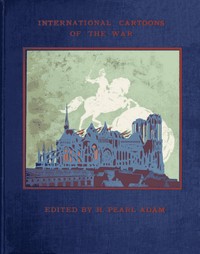
Before opening International cartoons of the war — A Closer Reading, the edition data offers a quick orientation: 10,088 words, 44 min estimated reading time, and 56 detected text sections.
The text analysis averages about 18.8 words per sentence, while the detected sections provide another way to judge how the source is divided.
Project Gutenberg metadata also associates the work with “World War, 1914-1918 -- Humor, caricatures, etc.,” connecting these edition facts with the source record’s subject description.
Explore this collection
These alternatives are selected using recorded categories and estimated reading time.
About 37 minutes
World Events
8,335 recorded words. 7 minutes difference from this book's estimate.
View Gutenberg source #76295About 16 minutes
World Events
3,461 recorded words. 28 minutes difference from this book's estimate.
View Gutenberg source #64904About 73 minutes
World Events
16,708 recorded words. 29 minutes difference from this book's estimate.
View Gutenberg source #7021Search stored excerpts and compare books → Choose by your preferences →
Choices use stored catalog measurements. Estimates vary with reading speed. A shared category is a catalog label, not a claim that two books have the same argument or literary quality.
Search reads excerpt text stored with this catalog and links to its associated Gutenberg record. The connection is stored in the site database; this tool does not recheck that every excerpt is word-for-word identical to that external record. Excerpt search does not cover every chapter and does not verify historical publication dates.
Catalog snapshot checked: 2026-09-26. Coverage: 100 public books, 100 available source excerpts.
Calculated from edition completeness, EPUB availability, text structure and catalogue metadata. Not a user rating.
Total of 100 points, scaled to a 2.5-5.0 range. Editions with an empty description or a missing EPUB file are not scored.
Public-domain source text
The source text is kept in the dedicated reader, separate from this catalogue record and its commentary.
The catalog subject 'World War, 1914-1918 -- Humor, caricatures, etc.' suggests a lighthearted collection, but the excerpts reveal a more complex tone. Adam's introduction frames the cartoons as a corrective to the 'seven different ways' history will be written, yet the images themselves range from dark satire to explicit atrocity depictions. The volume includes drawings from French periodicals like l'Anti-Boche and Le Mot, as well as Polish artist M. d'Ostoya's series. A recurring theme is the targeting of German militarism, often through caricatures of the Kaiser or Prussian officers, but the humor is frequently grim, as in Poulbot's drawing of a child urged to kill a spider—a metaphor for wartime desensitization.
The cartoons in this collection often employ humor not for mere entertainment but as a rhetorical tool. For instance, the drawing 'A Dinner at Headquarters' uses a quote from Heine to compare German leaders to pigs crowned with laurel—a pointed insult wrapped in literary allusion. Similarly, 'The Consultation on the Kaiser' depicts Dr. George and Dr. Albert discussing the effectiveness of '75 pills' (a reference to the French 75mm field gun), framing the war as a medical treatment for the Kaiser. These examples show how the cartoons blend wit with political commentary, targeting specific figures and policies.
However, not all humor is subtle. The cartoon 'In the Bagnio' shows a prisoner who killed his mother and another who says 'I was Emperor of Germany,' equating the Kaiser with a criminal. Such direct comparisons suggest that the collection's humor often serves to delegitimize the enemy, reinforcing the Allied cause.
Several cartoons focus on the victimization of children, challenging the notion that this is purely a humor collection. Poulbot's drawing of a child killing a spider with the caption 'Don't be frightened, kill her—I've got hold of her' uses a domestic scene to mirror the brutality of war. More starkly, 'The German Atrocities' depicts a seven-year-old boy shot for pointing a wooden gun at German soldiers. The caption notes this incident 'is alleged to have taken place in the village of Magny, Alsace,' and the image is described as part of a cheap series printed in 'colours the most brilliant and most naïve.'
These pieces operate as propaganda, eliciting outrage rather than laughter. The editor's commentary acknowledges the horror, noting that even Poulbot's 'sympathetic pencil lent itself to horror as easily as to mirth.' This duality—humor and horror coexisting—is a defining feature of the collection, complicating its catalog classification.
The excerpts include cartoons from French, Polish, and German sources, each with distinct stylistic and thematic approaches. The French cartoons, such as those by Poulbot and Baldo, often focus on everyday life and children, using irony to critique the enemy. Baldo's drawing of children mistaking a Zeppelin for a sausage—'if it had been a sausage the Boches would have eaten it long ago'—employs a child's logic to mock German greed.
In contrast, the Polish cartoonist M. d'Ostoya targets class and ethnic prejudice, as in the drawing where a Prussian officer dismisses a Jewish soldier despite his own 'thirteen quarterings of nobility.' This highlights internal tensions within the Central Powers. The German cartoon 'The Sacred Union' by Garcia Benito satirizes the French 'Union Sacrée' by showing a marchioness unable to distinguish friend from foe in uniform. Together, these examples demonstrate how the collection offers a multi-national perspective, though the editor's selections clearly favor the Allied viewpoint.
Readers should approach International Cartoons of the War not as a straightforward humor anthology but as a curated artifact of wartime visual culture. The editor's introduction and captions provide context, but the images themselves often resist simple categorization. Pay attention to the tension between the stated aim of providing 'unfailing guide' for future historians and the raw, propagandistic nature of many drawings. This collection rewards those who examine both the artistry and the ideology embedded in each frame.
Some evenings I linger over the wartime cartoons in International Cartoons of the War, where a Polish soldier's grin masks such weariness. It reminds me of another volume, that old History of the Revolt of the Netherlands — Volume 01 — Inside the Classic, whose pages hold the same quiet ache — how people laugh, briefly, to keep despair at arm's length.
Build a private reading journal entry for this title.