About 44 minutes
International cartoons of the war — A Closer Reading
World Events
10,088 recorded words. 7 minutes difference from this book's estimate.
View Gutenberg source #69107
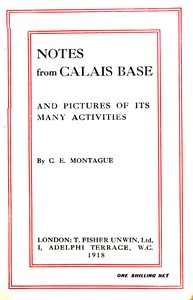
This digital edition of Notes from Calais base, and pictures of its many activities — Context and Discussion is described by source-level measurements including 8,335 words, 37 min estimated reading time, and 9 detected text sections.
The text analysis averages about 25.4 words per sentence, while the detected sections provide another way to judge how the source is divided.
Project Gutenberg metadata also associates the work with “World War, 1914-1918 -- Great Britain,” connecting these edition facts with the source record’s subject description.
Explore this collection
These alternatives are selected using recorded categories and estimated reading time.
About 44 minutes
World Events
10,088 recorded words. 7 minutes difference from this book's estimate.
View Gutenberg source #69107About 16 minutes
World Events
3,461 recorded words. 21 minutes difference from this book's estimate.
View Gutenberg source #64904About 73 minutes
World Events
16,708 recorded words. 36 minutes difference from this book's estimate.
View Gutenberg source #7021Search stored excerpts and compare books → Choose by your preferences →
Choices use stored catalog measurements. Estimates vary with reading speed. A shared category is a catalog label, not a claim that two books have the same argument or literary quality.
Search reads excerpt text stored with this catalog and links to its associated Gutenberg record. The connection is stored in the site database; this tool does not recheck that every excerpt is word-for-word identical to that external record. Excerpt search does not cover every chapter and does not verify historical publication dates.
Catalog snapshot checked: 2026-09-26. Coverage: 100 public books, 100 available source excerpts.
Calculated from edition completeness, EPUB availability, text structure and catalogue metadata. Not a user rating.
Total of 100 points, scaled to a 2.5-5.0 range. Editions with an empty description or a missing EPUB file are not scored.
Public-domain source text
The source text is kept in the dedicated reader, separate from this catalogue record and its commentary.
Montague opens not with a panoramic view of war but with the specific, almost technical process of training reinforcements in France. He compares the final instruction to "racing polish" put on a boat's crew or a university "post-graduate course," emphasizing that this is not basic training but a refinement of existing skills. The instructors are veterans fresh from the trenches, teaching the latest techniques from the Somme or Cambrai. This focus on the immediate, practical transmission of knowledge sets the tone for a work that examines war through its concrete, everyday operations rather than grand strategy.
The training schools at Calais are depicted as constantly evolving, with instructors who "come fresh from the trenches" and adapt lessons based on the latest experience. Montague stresses that the course is "tightly packed with work" and assumes prior knowledge, aiming only for "greater finish." The men are intensely keen to reach their regiments, and the instructors teach with "the zest of veterans relating their own experiences." This dynamic creates a sense of urgency and relevance, where every moment is used to impart skills that could mean survival. The description avoids romanticism, instead presenting a system designed for efficiency and immediate application.
Montague devotes considerable attention to the boot repair operation, a "huge cobbler's shop" employing 2,400 people, mostly French women and girls. He details the process from judgment to repair: boots are assessed, paired with leather allowances, and placed in pigeonholes. The division of labor is extreme—one man pares soles, another sews with a machine, another drives nails. The transformation of deformed boots back into shape is described as "miraculous" to the layman. Nothing is wasted: scraps become manure, heels fuel furnaces. Montague even quotes The Tempest to describe the "sea change" of decrepit boots into useful items, blending literary allusion with industrial observation.
Amid the detailed processes, Montague notes the human side: the French women workers are "extremely cheerful," sing most of the time, and look at British visitors with "amused curiosity." Each group has an educated Englishwoman as a volunteer friend and adviser. The workmen are British shoemakers by trade, enlisted specially for the work. These details ground the industrial description in personal observation, showing that the base is not just a machine but a community. Montague's tone is factual yet appreciative, highlighting the morale and organization without sentimentality.
The final stage of the boot's journey is described with almost ceremonial precision: after mending and oiling, the boots are ready for reissue. They go into a sack, are carried to a railway siding, and make the return journey to the Front. There, a quartermaster-sergeant will open the sack, and an order will go around for men in need. This cyclical process—from front to base and back—underscores the base's role as a vital link in the war effort. Montague's focus on the mundane object of a boot reveals the immense logistical network required to sustain an army, making the abstract war tangible through its material needs.
Montague's account is best read as a series of close observations rather than a narrative. The excerpts offer a ground-level view of how a base functions, from training to repair. Readers should attend to the specific details—the comparison of training to rowing, the division of labor in the boot factory, the cheerful French workers—as they reveal the author's method: using the particular to illuminate the whole. This is not a book about battles but about the machinery that makes battles possible.
That rainy afternoon, I lingered over Montague’s patient boot-menders, their stitching a quiet rhythm against the mud of Calais. The lesson wasn’t glory, but endurance—the slow, unglamorous work of holding things together. Later, idly, I found myself thinking of another frontier’s patient repair, and pulled down Indian Frontier Policy; an historical sketch — A Closer Reading. Different dust, same stubborn mending.
Answer a few questions and save a private reflection on this device.