About 37 minutes
Notes from Calais base, and pictures of its many activities — Context and Discussion
World Events
8,335 recorded words. 21 minutes difference from this book's estimate.
View Gutenberg source #76295
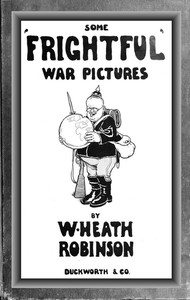
For Some 'Frightful' War Pictures — Story, Setting & Ideas, the stored edition analysis reports 3,461 words, 16 min estimated reading time, and 1 detected text section.
The text analysis averages about 22.5 words per sentence, while the detected sections provide another way to judge how the source is divided.
Project Gutenberg metadata also associates the work with “World War, 1914-1918 -- Humor, caricatures, etc.,” connecting these edition facts with the source record’s subject description.
Explore this collection
These alternatives are selected using recorded categories and estimated reading time.
About 37 minutes
World Events
8,335 recorded words. 21 minutes difference from this book's estimate.
View Gutenberg source #76295About 44 minutes
World Events
10,088 recorded words. 28 minutes difference from this book's estimate.
View Gutenberg source #69107About 73 minutes
World Events
16,708 recorded words. 57 minutes difference from this book's estimate.
View Gutenberg source #7021Search stored excerpts and compare books → Choose by your preferences →
Choices use stored catalog measurements. Estimates vary with reading speed. A shared category is a catalog label, not a claim that two books have the same argument or literary quality.
Search reads excerpt text stored with this catalog and links to its associated Gutenberg record. The connection is stored in the site database; this tool does not recheck that every excerpt is word-for-word identical to that external record. Excerpt search does not cover every chapter and does not verify historical publication dates.
Catalog snapshot checked: 2026-09-26. Coverage: 100 public books, 100 available source excerpts.
Calculated from edition completeness, EPUB availability, text structure and catalogue metadata. Not a user rating.
Total of 100 points, scaled to a 2.5-5.0 range. Editions with an empty description or a missing EPUB file are not scored.
_First published 1915_ _Reprinted 1916_
PRINTED IN GREAT BRITAIN AT THE COMPLETE PRESS WEST NORWOOD LONDON
The full-page drawings originally appeared in “The Sketch” and in “The Illustrated Sporting and Dramatic News.” The author is indebted to the proprietors of these journals for permission to issue them in this volume.
PRINTED IN GREAT BRITAIN AT THE COMPLETE PRESS WEST NORWOOD LONDON
W. Heath Robinson’s Some ‘Frightful’ War Pictures (1915) is a sequence of satirical full-page drawings that originally appeared in The Sketch and The Illustrated Sporting and Dramatic News. The volume’s structure is built around recurring categories: “Hague Convention Defied!” scenarios, “British Patent (applied for)” inventions, and glimpses of German “War Komforts.” Each image treats the machinery of war as a subject for elaborate, deadpan absurdity.
The drawings move between the Western Front, a Swiss frontier, and a London boarding house, but the setting is less important than the contraptions themselves. Robinson’s humour depends on intricate, over-engineered devices—button magnets, trench pressers, periscopers—that are both ridiculous and unsettlingly plausible. The captions, often in mock-German dialect, reinforce the sense of a war fought with gadgets as much as guns.
The volume groups its pictures under repeated headings that act as structural refrains. “Hague Convention Defied!” appears six times, each depicting a German scheme that violates the laws of war: using button magnets to disarm British soldiers, directing draughts to stiffen necks, or deploying a “Tommy-scalder.” The repetition turns the phrase into a running joke—the conventions are defied so often that defiance itself becomes routine.
“British Patent (applied for)” appears seven times, showcasing inventions like a drilling frame for recruits, a lancing wheel for cavalry, and a trench presser. The patent language mocks officialdom while the devices themselves are absurdly elaborate. A “trained Dog of War” draws enemy fire, and a game called “Picking the Pickelhaube” turns trench warfare into a sport. These categories create a rhythm: each picture promises a new variation on a familiar formula, rewarding readers who recognise the pattern.
Robinson shifts scenes abruptly, moving from the trenches to a Swiss mountain to a London boarding house. In “Neutral! A Swiss Shepherd watching a Battle on the Frontier,” the shepherd stands apart, an observer rather than a participant. The image underscores the war’s absurdity from a detached perspective.
Two pictures under “The Enemy in Our Midst!” bring the war home: a German spy trains a carrier pigeon in a boarding house, and an “Extra Special Constable” discovers a waiter laying a concrete gun-bed. These domestic settings make the threat both comic and intimate. The movement between front and home front suggests that the war’s machinery is not confined to the battlefield—it infiltrates everyday life, turning civilians into inventors, spies, or constables.
Several captions use mock-German dialect to heighten the comedy. In “Oh U! The German Periscoper,” a soldier exclaims, “Ach, Himmel! Dot most be der peautiful Ben Nevis of vich ve ’ave ’eard so mooch!” The mispronunciation and confusion about geography turn a periscope sighting into a joke about cultural ignorance.
Dialect also appears in “War Komforts! Some Notes in a German Bivouac,” where the comforts are likely as absurd as the inventions. The broken English underscores the enemy’s otherness while making him ridiculous rather than menacing. Robinson uses language as another layer of mechanical failure—communication itself becomes a faulty device.
Robinson’s inventions are never simple weapons; they are convoluted machines that perform simple tasks with maximum complexity. The “Trench Presser or Bosch Bayoneter” suggests a device that presses trenches and bayonets enemies in one motion. The “Outflanking Machine for Turning Movements” reduces strategy to a crank-turning operation.
These contraptions mirror the industrial scale of World War I while mocking the idea that technology can solve military problems neatly. The drawings are meticulous, with every pulley, pipe, and lever rendered in detail, but the results are always farcical. The humour lies in the gap between the elaborate means and the trivial or horrific ends—a pattern that recurs across the collection, from the “Tommy-scalder” to the “Laughing Gas” siphon.
Readers should approach Some ‘Frightful’ War Pictures as a sequence of visual jokes that depend on repetition and variation. The categories and recurring motifs reward sequential reading, but individual pictures can be enjoyed out of order. Pay attention to the captions: they often undercut or extend the image’s meaning. Robinson’s humour is dry, mechanical, and occasionally dark—a reminder that satire can be both a weapon and a toy.
Flipping through W. Heath Robinson’s absurd war contraptions, I found myself thinking less about the laughter and more about the quiet patience behind them—the way we document what we survive. That earnestness surfaced again when I later stumbled upon The Sword and Gun: A History of the 37th Wis. Volunteer Infantry — Edition Insights. Same war, different tremor, yet both left me holding my breath a little longer.
Answer a few questions and save a private reflection on this device.