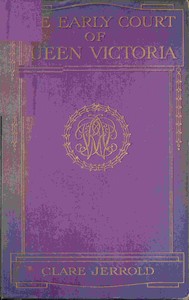
About 471 minutes
The early court of Queen Victoria — Context and Discussion
Social History
108,310 recorded words. 30 minutes difference from this book's estimate.
View Gutenberg source #74776
This digital edition of Mormon Settlement in Arizona A Record of Peaceful Conquest of the Desert — A Closer Reading is described by source-level measurements including 101,361 words, 7 hr 21 min estimated reading time, and 10 detected text sections.
The text analysis averages about 18.0 words per sentence, while the detected sections provide another way to judge how the source is divided.
Project Gutenberg metadata also associates the work with “Latter Day Saints -- Arizona -- History,” connecting these edition facts with the source record’s subject description.
Explore this collection
These alternatives are selected using recorded categories and estimated reading time.
About 471 minutes
Social History
108,310 recorded words. 30 minutes difference from this book's estimate.
View Gutenberg source #74776About 530 minutes
Social History
121,701 recorded words. 89 minutes difference from this book's estimate.
View Gutenberg source #11859About 555 minutes
Social History
127,581 recorded words. 114 minutes difference from this book's estimate.
View Gutenberg source #15729Search stored excerpts and compare books → Choose by your preferences →
Choices use stored catalog measurements. Estimates vary with reading speed. A shared category is a catalog label, not a claim that two books have the same argument or literary quality.
Search reads excerpt text stored with this catalog and links to its associated Gutenberg record. The connection is stored in the site database; this tool does not recheck that every excerpt is word-for-word identical to that external record. Excerpt search does not cover every chapter and does not verify historical publication dates.
Catalog snapshot checked: 2026-09-26. Coverage: 100 public books, 100 available source excerpts.
Calculated from edition completeness, EPUB availability, text structure and catalogue metadata. Not a user rating.
Total of 100 points, scaled to a 2.5-5.0 range. Editions with an empty description or a missing EPUB file are not scored.
Public-domain source text
The source text is kept in the dedicated reader, separate from this catalogue record and its commentary.
James H. McClintock's Mormon Settlement in Arizona opens with a foreword that immediately establishes the work's dual character: it is both a commissioned history and a personal compilation. The author acknowledges assistance from Governor Thos. E. Campbell and the Mormon Church Historian's office, noting that 'the immense resources of his office have been offered freely.' This phrasing reveals McClintock's reliance on institutional records, yet the text also incorporates firsthand accounts from pioneers, creating a layered narrative where official data and individual testimony coexist.
McClintock's word choice often reflects the bureaucratic and ecclesiastical frameworks that shaped his sources. Terms like 'verification of data,' 'checking and correcting,' and 'carefully compiled' signal a methodical approach to history. Yet his diction also carries a sense of movement and conquest, as in the subtitle 'A Record of Peaceful Conquest of the Desert.' The verb 'conquest' is softened by 'peaceful,' suggesting a narrative of settlement that downplays conflict. In describing the salt lake of the Zuni, he writes that 'salt for the early settlements... very generally was secured from' that source, using the passive voice to emphasize the resource's availability rather than the labor of extraction.
Direct dialogue is sparse, but McClintock occasionally incorporates reported speech from pioneers, as when he notes that 'John Bushman is believed to have been the first Mormon resident of the locality.' The phrase 'is believed to' hedges authority, reflecting the oral nature of such claims. In the account of the sawmill, he writes that the mill 'was given by the Church authorities to the struggling Little Colorado River settlements,' a construction that attributes agency to the Church while leaving the recipients passive. This pattern recurs throughout, with institutional voices dominating over individual ones.
McClintock's descriptions often anchor events to specific locations, using directional phrases like '28 miles southeast of Flagstaff' or 'seven miles south of Pleasant Valley.' This geographic precision grounds the narrative in measurable space. He also tracks the movement of objects, such as the sawmill that 'was transferred to Pinedale and in 1890 to Pinetop' and 'now is at Lakeside.' The mill's journey mirrors the settlers' own migrations, but McClintock rarely lingers on the human cost of such relocations. Instead, he focuses on the continuity of machinery and place names, as when he notes that 'Mormon Dairy and the Mount Trumbull Mill' still bear their original names.
Throughout the excerpts, McClintock returns to the theme of infrastructure: sawmills, dairies, salt sources, and springs. These details serve as anchors for the narrative of settlement. He also pays close attention to naming practices, explaining that 'Fort Rickerson' was renamed in honor of a company treasurer, and that 'LeRoux spring was named for Antoine LeRoux.' Such etymologies reveal how the landscape was inscribed with the names of leaders and benefactors. The author's own role as compiler is acknowledged in the foreword, where he mentions '2000 letters' written and 'an immense quantity of typewritten matter' indexed, underscoring the archival labor behind the published text.
Readers approaching McClintock's work should attend to the tension between its institutional sponsorship and its reliance on personal testimony. The author's diction, use of reported speech, and descriptive focus on infrastructure reveal a history that is as much about record-keeping as about settlement. By noting these authorial choices, one can better appreciate how the text constructs a narrative of 'peaceful conquest' through the accumulation of data and the naming of places.
McClintock’s ledger-like prose still holds the desert’s heat, yet every so often his own voice slips past the entries—a quiet, personal warmth beneath the official record. That same tenderness colors The early court of Queen Victoria — Context and Discussion, where ceremony and private memory breathe together, two old friends sharing a knowing glance across the stacks.
Capture what you thought, learned, and would like to remember.






![Cover of History of the Jews in Russia and Poland, Volume 2 [of 3] From the Death of Alexander I until the Death of Alexander III (1825-1894) — Inside the Classic](https://uhuqu.com/storage/media/covers/pg15729.jpg)