About 359 minutes
Korea's Fight for Freedom — Text and Context
Revolutions
82,528 recorded words. 8 minutes difference from this book's estimate.
View Gutenberg source #13368
Ireland and the Home Rule Movement — Key Ideas to Explore can be approached with a clearer sense of reading commitment from its source measurements: 84,227 words, 6 hr 7 min estimated reading time, and 11 detected text sections.
The text analysis averages about 33.2 words per sentence, while the detected sections provide another way to judge how the source is divided.
Project Gutenberg metadata also associates the work with “Home rule -- Ireland,” connecting these edition facts with the source record’s subject description.
Explore this collection
These alternatives are selected using recorded categories and estimated reading time.
About 359 minutes
Revolutions
82,528 recorded words. 8 minutes difference from this book's estimate.
View Gutenberg source #13368About 296 minutes
Revolutions
68,036 recorded words. 71 minutes difference from this book's estimate.
View Gutenberg source #5997About 241 minutes
Revolutions
55,245 recorded words. 126 minutes difference from this book's estimate.
View Gutenberg source #8543Search stored excerpts and compare books → Choose by your preferences →
Choices use stored catalog measurements. Estimates vary with reading speed. A shared category is a catalog label, not a claim that two books have the same argument or literary quality.
Search reads excerpt text stored with this catalog and links to its associated Gutenberg record. The connection is stored in the site database; this tool does not recheck that every excerpt is word-for-word identical to that external record. Excerpt search does not cover every chapter and does not verify historical publication dates.
Catalog snapshot checked: 2026-09-26. Coverage: 100 public books, 100 available source excerpts.
Calculated from edition completeness, EPUB availability, text structure and catalogue metadata. Not a user rating.
Total of 100 points, scaled to a 2.5-5.0 range. Editions with an empty description or a missing EPUB file are not scored.
Public-domain source text
The source text is kept in the dedicated reader, separate from this catalogue record and its commentary.
Michael F. J. McDonnell's Ireland and the Home Rule Movement (1908) opens with a preface by John Redmond, the Irish Parliamentary Party leader, who immediately frames the book as a weapon against British ignorance of Irish affairs. Redmond praises McDonnell for dealing 'in particular facts' and giving his authorities, a claim that the reader can test from the first chapter onward. The book's dedication 'Matri dilectissimae' (to his dearest mother) adds a personal note before the political argument begins.
The opening excerpts establish a clear rhetorical strategy: McDonnell does not assume prior knowledge but instead builds his case from documented grievances, such as the history of educational discrimination. Redmond's preface warns that the book is not a work of rhetoric but a 'scholarly study' grounded in evidence, setting expectations for a methodical, citation-heavy approach.
John Redmond's preface is more than a endorsement; it is a strategic document that tells the reader how to read McDonnell. Redmond states that the book combats 'the deep and almost universal ignorance in Great Britain regarding Irish affairs present and past,' and he specifically notes that McDonnell 'condensed into a few pages the more vital points of many volumes.' This framing alerts the reader that the text will be dense with references and that each chapter is intended to dismantle a specific prejudice.
Redmond also reveals the political context: after the defeat of the first Home Rule Bill in 1886, Parnell established an English propaganda agency, and McDonnell's book continues that work. The preface thus positions the volume as part of a sustained campaign, not a neutral history. Readers should note that Redmond adds a caveat—he does not agree with 'every expression of opinion'—which hints at internal debates within the Irish nationalist movement.
Chapter VI, 'The Educational Problem,' exemplifies McDonnell's method. He opens with two epigraphs: one from Macaulay's 1845 speech on the Maynooth Grant, and one from Matthew Arnold's Mixed Essays. Both quotations contrast the wealth of Oxford and Cambridge with the poverty of Irish Catholic education. Macaulay's reference to 'the miserable Dotheboys Hall which we have given them in exchange' is a striking literary allusion that McDonnell lets stand as an indictment.
McDonnell then traces the history of Irish education from the Charter Schools of 1730—'frankly proselytising agencies'—through the Kildare Street Schools and the National System established in 1833. He notes that John Howard condemned the Charter Schools as 'a disgrace to Protestantism and a disgrace to all society,' yet they cost the public 'nearly two millions of money.' The chapter argues that the National System, despite initial hopes, was captured by Protestant ascendancy, leaving Catholic education in chaos. This section shows McDonnell's reliance on parliamentary reports and historical records to build his case.
McDonnell's prose is measured but pointed. He avoids emotional appeals, instead letting facts and quotations carry the argument. For example, he writes that 'the fact that the recurrent educational problem in England is that of the Elementary Schools, while as to Ireland the only question which is ever to any extent ventilated is that of University Education, has led to the totally wrong impression that everything in this sphere in Ireland, with the exception of Higher Education, is in a satisfactory condition.' This sentence reveals his technique: he identifies a common misconception, then systematically refutes it with evidence.
The excerpts show that McDonnell frequently cites authorities—Macaulay, Arnold, Howard—and uses parliamentary grants and dates to anchor his narrative. He does not simply assert injustice; he documents it. Readers should pay attention to the footnotes and references, which are integral to his argument. The book's structure, moving from general principles to specific cases like education, suggests a deliberate pedagogical design.
The provided excerpts cover only the preface and one chapter, so the full scope of McDonnell's argument remains unclear. The catalog lists 11 text sections and 84,227 words, indicating a comprehensive treatment. However, we cannot infer how McDonnell handles other topics such as land reform, the Union, or the political history of the Home Rule movement. The excerpts do not reveal his treatment of key figures like Parnell or Gladstone, nor do they show his conclusions.
Readers should be cautious about generalizing from the educational chapter alone. McDonnell's method may vary across subjects, and his tone might shift when discussing more contentious events. The preface's mention of 'the inexorable logic of his method' suggests a consistent approach, but the excerpts do not confirm this. A first-time reader should approach the book as a series of independent essays, each building a case from primary sources, rather than a continuous narrative.
McDonnell's Ireland and the Home Rule Movement rewards careful reading. The preface and educational chapter demonstrate a writer who trusts evidence over rhetoric, but who also knows how to select a damning quotation. Readers unfamiliar with Irish history may find the density of references challenging, but the book's structure—each chapter addressing a distinct grievance—makes it possible to read selectively. Pay attention to the footnotes and the dates; they are the scaffolding of McDonnell's argument. This is a work of advocacy disguised as scholarship, and its power lies in the details.
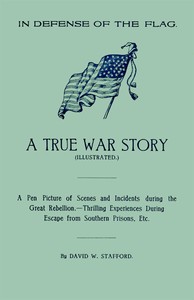
There’s something touching about how McDonnell’s evidence mattered less than the patient act of explanation itself, a bridge of words to quiet misunderstanding. It reminds me of another earnest voice, older and rougher, trying to make sense of war through memory. That need to witness remains, felt again in In Defense of the Flag: A true war story A pen picture of scenes and incidents during the great rebellion.--Thrilling experiences during escape from southern prisons, etc. — Reading Notes, a quieter ache for being understood.
Save your reaction, strongest insight, and memorable passage.