About 241 minutes
The Great North-Western Conspiracy in All Its Startling Details — Background and Themes
Revolutions
55,245 recorded words. 55 minutes difference from this book's estimate.
View Gutenberg source #8543

Before opening Maximilian in Mexico: A Woman's Reminiscences of the French Intervention 1862-1867 — Key Ideas to Explore, the edition data offers a quick orientation: 68,036 words, 4 hr 56 min estimated reading time, and 6 detected text sections.
The text analysis averages about 24.0 words per sentence, while the detected sections provide another way to judge how the source is divided.
Project Gutenberg metadata also associates the work with “Maximilian, Emperor of Mexico, 1832-1867,” connecting these edition facts with the source record’s subject description.
Explore this collection
These alternatives are selected using recorded categories and estimated reading time.
About 241 minutes
Revolutions
55,245 recorded words. 55 minutes difference from this book's estimate.
View Gutenberg source #8543About 359 minutes
Revolutions
82,528 recorded words. 63 minutes difference from this book's estimate.
View Gutenberg source #13368About 367 minutes
Revolutions
84,227 recorded words. 71 minutes difference from this book's estimate.
View Gutenberg source #13998Search stored excerpts and compare books → Choose by your preferences →
Choices use stored catalog measurements. Estimates vary with reading speed. A shared category is a catalog label, not a claim that two books have the same argument or literary quality.
Search reads excerpt text stored with this catalog and links to its associated Gutenberg record. The connection is stored in the site database; this tool does not recheck that every excerpt is word-for-word identical to that external record. Excerpt search does not cover every chapter and does not verify historical publication dates.
Catalog snapshot checked: 2026-09-26. Coverage: 100 public books, 100 available source excerpts.
Calculated from edition completeness, EPUB availability, text structure and catalogue metadata. Not a user rating.
Total of 100 points, scaled to a 2.5-5.0 range. Editions with an empty description or a missing EPUB file are not scored.
Public-domain source text
The source text is kept in the dedicated reader, separate from this catalogue record and its commentary.
Sara Yorke Stevenson opens her account not with a personal anecdote but with a detailed analysis of the Triple Alliance negotiations, quoting a French orator who warned that Napoleon III's Mexican adventure would require "a sacrifice of forty thousand men and a yearly expenditure of four or five millions" for a decade. This early reliance on parliamentary speeches sets the tone: Stevenson frequently steps aside to let contemporary voices—French deputies, Mexican ministers, even Cardinal Antonelli—speak at length, creating a layered narrative that moves between her own observations and documentary evidence.
The author's voice is notably restrained. She describes Maximilian's court, the "pageants and ovations" of his provincial journeys, and the lavish alterations at Chapultepec without overt judgment, yet the accumulating details of mismanagement and waning confidence build a quiet case against the imperial project. Her perspective as a woman in a male-dominated political world is understated but present: she notes the "incapacity of Maximilian" becoming "generally recognized" without fanfare, letting the facts accumulate.
Stevenson's narrative technique is distinctive: she often retreats from first-person commentary to present extended quotations from official documents, speeches, and letters. In the excerpted passage, a French deputy's warning about Napoleon I's Spanish campaign is quoted verbatim, including the formal language of the Senate's deposition decree. This method gives the account an almost legalistic weight, as if Stevenson is assembling evidence rather than telling a story. The effect is to distance the author from direct emotional engagement while allowing the contradictions of the intervention to emerge through the words of its proponents.
When she does offer her own analysis, it is terse and understated. Of the French Chamber's vote to fund the expedition, she writes that "it is only fair to believe" many voted for it out of national honor rather than conviction. This restraint is consistent throughout: she rarely raises her voice, preferring to let the accumulating facts—the "millions raised through the Mexican loans" carelessly spent, the alienation of the church, the failure to win Liberal support—speak for themselves.
The narrative pace in the excerpt is deliberate, almost stately. Stevenson builds her case through a series of concrete observations: the cost of the expedition, the lavish spending on Chapultepec, the emperor's journeys, the growing recognition of his incapacity. Each detail is presented without rhetorical flourish, yet the cumulative effect is one of inexorable decline. The shift from the orator's prophetic warning to the dry list of Maximilian's failures—alienating Rome, arousing priestly resentment, failing to win Liberal adhesions—creates a sense of historical inevitability.
This pacing is not uniform across the book; the table of contents suggests a movement from diplomatic prelude (Part I) through military action (Part II) to the empire's rise and fall (Parts III–V). The excerpt, drawn from the later sections, shows Stevenson at her most analytical, compressing months of political maneuvering into a few paragraphs. The effect is to foreground the structural weaknesses of the imperial project rather than the drama of individual events.
Stevenson's position as a woman writing about high politics in the 1860s is unusual, and she navigates it with a careful balance of authority and modesty. She does not claim to have been a direct participant in the events she describes; instead, she presents herself as a witness who has gathered and weighed evidence. The dedication to Matias Romero, a Mexican minister, and the acknowledgment that the book grew from magazine articles suggest a network of informed sources.
Her language is precise and unemotional: Maximilian "had alienated Rome," "had aroused the resentment of the priests," "had not succeeded in winning over" Liberal leaders. The passive constructions and factual tone create an impression of objectivity, even as the selection of details reveals a critical perspective. This voice—learned, measured, and quietly damning—gives the memoir a documentary quality that sets it apart from more personal accounts of the period.
Readers should pay attention to how Stevenson uses quotations: they are not decorative but structural, often carrying the argument where her own voice might seem partisan. The book rewards those who read slowly, noting how each document or speech is positioned to reveal a gap between rhetoric and reality. The appendices—including the full text of the "Bando Negro" and the Treaty of Miramar—are essential to understanding the legal and political framework she critiques. Approach the text as a work of historical analysis as much as a memoir, and the quiet force of Stevenson's method becomes clear.
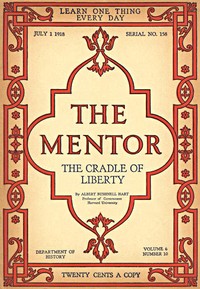
Reading Sara Yorke Stevenson’s recollections of Maximilian’s court, I felt the odd weight of a nation’s story told through quiet, personal detail. It reminded me of an old volume I once leafed through, The Mentor: The Cradle of Liberty, Vol. 6, Num. 10, Serial No. 158, July 1, 1918 — Text and Context, which similarly held history’s grandeur in its modest pages—both felt like letters from a slower time.
Answer a few questions and save a private reflection on this device.