About 61 minutes
The Battle of San Jacinto and the San Jacinto Campaign — Context and Discussion
Revolutions
13,984 recorded words. 3 minutes difference from this book's estimate.
View Gutenberg source #57849
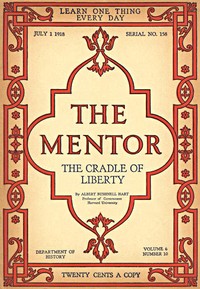
The Mentor: The Cradle of Liberty, Vol. 6, Num. 10, Serial No. 158, July 1, 1918 — Text and Context can be approached with a clearer sense of reading commitment from its source measurements: 13,164 words, 58 min estimated reading time, and 7 detected text sections.
The text analysis averages about 23.2 words per sentence, while the detected sections provide another way to judge how the source is divided.
Project Gutenberg metadata also associates the work with “United States -- History -- Revolution, 1775-1783 -- Anecdotes,” connecting these edition facts with the source record’s subject description.
Explore this collection
These alternatives are selected using recorded categories and estimated reading time.
About 61 minutes
Revolutions
13,984 recorded words. 3 minutes difference from this book's estimate.
View Gutenberg source #57849About 63 minutes
Revolutions
14,452 recorded words. 5 minutes difference from this book's estimate.
View Gutenberg source #4801About 109 minutes
Revolutions
25,009 recorded words. 51 minutes difference from this book's estimate.
View Gutenberg source #12033Search stored excerpts and compare books → Choose by your preferences →
Choices use stored catalog measurements. Estimates vary with reading speed. A shared category is a catalog label, not a claim that two books have the same argument or literary quality.
Search reads excerpt text stored with this catalog and links to its associated Gutenberg record. The connection is stored in the site database; this tool does not recheck that every excerpt is word-for-word identical to that external record. Excerpt search does not cover every chapter and does not verify historical publication dates.
Catalog snapshot checked: 2026-09-26. Coverage: 100 public books, 100 available source excerpts.
Calculated from edition completeness, EPUB availability, text structure and catalogue metadata. Not a user rating.
Total of 100 points, scaled to a 2.5-5.0 range. Editions with an empty description or a missing EPUB file are not scored.
Public-domain source text
The source text is kept in the dedicated reader, separate from this catalogue record and its commentary.
Albert Bushnell Hart opens this 1918 installment of The Mentor with a sweeping claim: “Liberty is older than Law, older than Government, older than the State.” The sentence sets a declarative, almost oratorical tone that persists throughout the essay. Hart, a Harvard professor, writes as a public intellectual rather than a detached historian, using direct address and pointed contrasts. He insists that American liberty did not simply copy British models, but instead developed independently from shared sixteenth- and seventeenth-century roots. The prose moves between grand pronouncements and concrete details—Peter Faneuil’s “amber wine” and “crested harness” appear alongside the abstract “pole-star of peoples.” This blend of the particular and the philosophical gives the essay a distinctive rhythm, shifting from market stalls to constitutional principles within a few paragraphs.
Hart devotes the first major section to the building itself, treating Faneuil Hall almost as a protagonist. He quotes an unnamed source calling it “that guild temple of traders and aldermen, butchers and clerks, hucksters and civic magistrates,” then immediately pivots to the biography of its donor. Peter Faneuil is described as a “young bachelor” descended from Huguenot refugees, a merchant prince who ordered “amber wine” from Madeira and “chariots and sets of crested harness” from London. The prose lingers on these material details—tobacco, black walnut, fish, stoves—before noting that the hall above the market became “the seat of public offices” and a venue for “patriotic celebrations, debates and banquets.” Hart’s method is associative: he moves from the building’s physical origins to its symbolic role, but he never loses sight of the specific historical actors and objects that anchor his argument.
Hart explicitly challenges the notion that American government derived from British parliamentary practices. “This is not accurate,” he states flatly. He points out that the United States created written constitutions while Britain had none, and that America expanded suffrage “while England slowly followed on that highway of liberty.” The colonies, he argues, were “very nearly independent little republics” who loved their kings only when those kings “kept their hands off.” The Revolution, in Hart’s telling, was not a rebellion against oppression but a preemptive strike by people who were already “freer, happier and more prosperous than the mother country.” He acknowledges that colonial liberty was incomplete—it did not extend to “Indians, or Negroes, or Quakers”—but insists that the colonies were “about half a century earlier than England in establishing … the priceless right publicly to criticize their own governments,” citing the 1734 Zenger case.
Hart presents Connecticut’s 1639 Fundamental Orders as “the first written constitution in history that was adopted by a people and that also organized a government.” He quotes a description of its twelve articles as expressing “pure democracy acting through representation, and imposing organic limitations.” The language here becomes almost reverential: “Here is the first practical assertion of the right of the people, not only to choose, but to limit the powers of their rulers.” Hart ties this document to the preaching of Thomas Hooker, claiming that “on the banks of the Connecticut … we draw the first breath of that atmosphere which is now so familiar to us.” The shift from Faneuil Hall’s commercial origins to Connecticut’s constitutional innovation illustrates Hart’s method of grounding abstract liberty in specific places and texts. He does not narrate the full history of the Orders, but uses them as evidence for his central thesis about the indigenous roots of American freedom.
Hart’s essay is best read as a series of linked vignettes rather than a continuous narrative. The transitions between sections can be abrupt, and the argument sometimes relies on assertion more than evidence. Readers should pay attention to the rhetorical strategies—the repeated use of direct quotations, the sudden shifts from the concrete to the abstract, and the way Hart positions himself as correcting common misconceptions. The essay’s value lies less in its historical originality than in its snapshot of how a prominent scholar presented the Revolution to a popular audience in 1918, at a moment when questions of liberty and national identity were especially urgent.
Reading Hart’s words about Faneuil Hall feels like standing in that old, wooden quiet, where liberty was more a habit than a slogan. It makes me think of other struggles where freedom had to be won on the ground, not just debated. That older account of The Battle of San Jacinto sits on my shelf, a reminder of how quickly the words become blood and dust. The Battle of San Jacinto and the San Jacinto Campaign — Context and Discussion stayed with me for that reason.
Build a private reading journal entry for this title.