About 63 minutes
The Rise of the Dutch Republic — Volume 01: Introduction I — Background and Themes
Revolutions
14,452 recorded words. 2 minutes difference from this book's estimate.
View Gutenberg source #4801
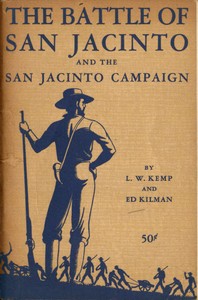
The Battle of San Jacinto and the San Jacinto Campaign — Context and Discussion can be approached with a clearer sense of reading commitment from its source measurements: 13,984 words, 1 hr 1 min estimated reading time, and 2 detected text sections.
The text analysis averages about 15.5 words per sentence, while the detected sections provide another way to judge how the source is divided.
Project Gutenberg metadata also associates the work with “Texas -- History -- Revolution, 1835-1836,” connecting these edition facts with the source record’s subject description.
Explore this collection
These alternatives are selected using recorded categories and estimated reading time.
About 63 minutes
Revolutions
14,452 recorded words. 2 minutes difference from this book's estimate.
View Gutenberg source #4801About 58 minutes
Revolutions
13,164 recorded words. 3 minutes difference from this book's estimate.
View Gutenberg source #51556About 109 minutes
Revolutions
25,009 recorded words. 48 minutes difference from this book's estimate.
View Gutenberg source #12033Search stored excerpts and compare books → Choose by your preferences →
Choices use stored catalog measurements. Estimates vary with reading speed. A shared category is a catalog label, not a claim that two books have the same argument or literary quality.
Search reads excerpt text stored with this catalog and links to its associated Gutenberg record. The connection is stored in the site database; this tool does not recheck that every excerpt is word-for-word identical to that external record. Excerpt search does not cover every chapter and does not verify historical publication dates.
Catalog snapshot checked: 2026-09-26. Coverage: 100 public books, 100 available source excerpts.
Calculated from edition completeness, EPUB availability, text structure and catalogue metadata. Not a user rating.
Total of 100 points, scaled to a 2.5-5.0 range. Editions with an empty description or a missing EPUB file are not scored.
Public-domain source text
The source text is kept in the dedicated reader, separate from this catalogue record and its commentary.
The narrative of this 1947 work moves from the Mexican edict of April 6, 1830, through the siege of the Alamo and the subsequent “Runaway Scrape,” to the battle itself—a fight that lasted less than twenty minutes. The authors, L. W. Kemp and Ed Kilman, structure the account around two distinct temporal frames: the long buildup of grievances and the sudden, compressed violence of the engagement. Recurring images of flight and pursuit, such as Mrs. Almeron Dickinson trudging toward Gonzales with her babe, anchor the human cost in specific, bodily detail.
The work opens by tracing the revolution’s origins to the Mexican edict of April 6, 1830, which prohibited further Anglo-American emigration. This legislative act is presented as the first in a chain of provocations that includes the disturbance at Anahuac, the battle of Velasco, and the imprisonment of Stephen F. Austin. The authors then shift to the immediate crisis: the fall of the Alamo and the panic it triggered. The phrase “Runaway Scrape” is used to describe the exodus of frantic colonists, a movement that contrasts with the disciplined retreat of Houston’s army. The text emphasizes the terror of civilians, not just soldiers, and the image of Mrs. Dickinson carrying her infant through the countryside after witnessing her husband’s death grounds the abstract concept of “massacre” in a specific, harrowing journey.
Sam Houston’s movements are presented as a series of tactical decisions made under duress. Upon learning of the Alamo’s fall, he left Washington-on-the-Brazos for Gonzales to take command, only to find the town in chaos. The authors quote Houston’s statement from two days before the battle: “This morning we are in preparation to meet Santa Anna. It is the only chance of saving Texas.” The general’s words reveal a commander aware of the odds—he notes having only about seven hundred men—and framing the engagement as “wisdom growing out of necessity.” The text does not glorify the retreat but presents it as a grim calculation, with Houston relying on providence while acknowledging that “no previous occasion would justify it.” This section underscores the structural tension between the army’s dwindling numbers and the imperative to fight.
A substantial portion of the text is devoted to the inscriptions on the San Jacinto monument, which the authors reproduce in full. These inscriptions serve as a secondary narrative layer, preserving the words of Houston and Thomas J. Rusk alongside the names of the fallen. Rusk’s report, dated “the day after the battle,” employs a dramatic contrast: “The sun was sinking in the horizon as the battle commenced, but, at the close of the conflict, the sun of liberty and independence rose in Texas.” The monument also records the war cries “Remember the Alamo” and “Remember Goliad,” as well as the love song “Will You Come to the Bower,” said to have been played on a flute during the charge. This juxtaposition of martial epitaphs and a popular tune highlights the range of emotional registers the authors weave into the record.
The final section of the work is a roster of participants: officers and men who fought on April 21, 1836, and those left at Harrisburg two days prior. The list is presented as a “Roll of Honor,” with names arranged alphabetically from Adams to Arreola. This catalog serves as a structural anchor, shifting the focus from narrative to commemoration. The authors note that two bronze plaques in the San Jacinto museum record these names, one for the combatants and another for the non-effective troops. By ending with this enumeration, the work emphasizes the individual soldiers over the generals, grounding the campaign in the bodies of the 910 men Houston led. The inclusion of names like Benjamin Rice Brigham, who was mortally wounded, and Olwyn J. Trask, who died later on Galveston Island, extends the battle’s timeline beyond the twenty-minute engagement.
Readers should note that the text is structured as a commemorative document as much as a historical account. The movement between narrative prose, quoted speeches, and transcribed monument inscriptions creates a layered reading experience. The authors do not analyze the battle’s tactics in depth but instead assemble primary materials—Houston’s address, Rusk’s report, the roster—that invite the reader to consider how the event was memorialized. The recurring emphasis on names and cries (“Remember the Alamo”) suggests that the work’s purpose is to preserve the texture of the campaign’s memory, not merely its chronology.
Reading about the Runaway Scrape, how ordinary people carried what they could and simply walked, I thought of another kind of endurance—the long, unglamorous march in The History of the Twenty-ninth Regiment of Massachusetts Volunteer Infantry in the Late War of the Rebellion — Story, Setting & Ideas. Both are so often reduced to a single battle, yet the hardest days were the ones between the edicts and the shouting.
Build a private reading journal entry for this title.