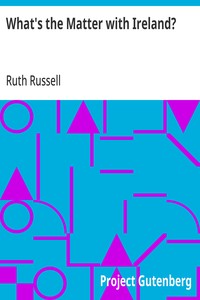
What's the Matter with Ireland? — Edition Insights

(0 User reviews)   120
In Category - Revolutions
Russell, Ruth Project Gutenberg 2004 Not confirmed
Irish question; Ireland -- History -- War of Independence, 1919-1921 Readers of public-domain and historical texts
Project Gutenberg digital edition en

Edition facts

Words 25,009
Reading time 109 min
Text sections 3

The source record for What's the Matter with Ireland? — Edition Insights measures this digital text at 25,009 words, 1 hr 49 min estimated reading time, and 3 detected text sections.

The text analysis averages about 16.6 words per sentence, while the detected sections provide another way to judge how the source is divided.

Project Gutenberg metadata also associates the work with “Irish question,” connecting these edition facts with the source record’s subject description.

Explore this collection

Compare your next read

These alternatives are selected using recorded categories and estimated reading time.

Search stored excerpts and compare books → Choose by your preferences →

How these choices and excerpts are prepared

Choices use stored catalog measurements. Estimates vary with reading speed. A shared category is a catalog label, not a claim that two books have the same argument or literary quality.

Search reads excerpt text stored with this catalog and links to its associated Gutenberg record. The connection is stored in the site database; this tool does not recheck that every excerpt is word-for-word identical to that external record. Excerpt search does not cover every chapter and does not verify historical publication dates.

Catalog snapshot checked: 2026-09-26. Coverage: 100 public books, 100 available source excerpts.

Ruth Russell's 1920 investigation into Irish poverty and politics, drawing on firsthand interviews and observations to examine Sinn Féin, labor movements, and the push for independence.
Share
Editorial Edition Score 4.5/5

Calculated from edition completeness, EPUB availability, text structure and catalogue metadata. Not a user rating.

How this score is calculated
  • Description quality20 pts
  • Title & short description10 pts
  • Source metadata20 pts
  • Text length15 pts
  • Chapters / structure15 pts
  • EPUB file integrity20 pts

Total of 100 points, scaled to a 2.5-5.0 range. Editions with an empty description or a missing EPUB file are not scored.

Edition quality

Public-domain source text

Read the source text

The source text is kept in the dedicated reader, separate from this catalogue record and its commentary.

Ruth Russell opens her 1920 inquiry with a journalist's challenge: a fellow reporter, exasperated by Ireland's persistent troubles, asks her to find out 'what is the matter with Ireland.' She sails from America and quickly concludes that Ireland is poor—'poor to ignorance, poor to starvation, poor to insanity and death'—and that the cause is exploitation by 'the world capitalist next door.' The book's structure reflects this direct, investigative approach: each chapter tackles a different force—Sinn Féin, labor, the Catholic Church—and Russell lets her sources speak at length. A foreword by Éamon de Valera praises her for grasping 'the Irish viewpoint' and for being an 'impartial investigator' who saw conditions firsthand.

A Reporter's Eye on Poverty

Russell's method is concrete and visual. She describes a Donegal farmer whose land is so stony that 'fires must be built about the stones so that the soil will lose its grip upon them.' Near Dungloe, a 600-acre holding was valued at $10.50. These details are not decorative; they anchor her argument that Irish poverty is structural, not accidental. She also notes the 'slave market' hiring fairs where farmhands 'stands between the mooing cows and snorting pigs' to offer their labor for as little as $100 a year. The evidence is drawn from observation and interviews, not statistics alone.

Voices of the Labor Movement

Russell gives extended space to labor leaders. Thomas Johnson, treasurer of the Irish Labour Party, tells her: 'Certainly we mean to take over industry by force if necessary.' James Connolly, executed in 1916, is quoted on the 'one big union' as a tool for both 'industrial warfare' and 'social administration of the future.' Nora Connolly, described as a 'smiling boy-like girl who smokes and works by a grate in Liberty Hall,' recounts her father's final hours. These portraits humanize the political program, showing the personalities behind the slogans.

The Republic First, Class War Later

A key tension in the book is the sequencing of revolution. Russell reports that labor agrees with Sinn Féin on independence first: 'After the national war, the class war must come.' She notes that many socialists abroad could not understand Connolly's participation in the 1916 rebellion. The excerpts suggest Russell is documenting a movement that sees national liberation as a prerequisite for social transformation, not a distraction from it. This strategic priority shapes the alliances and conflicts she describes.

The Limits of the Excerpts

The available passages cover only the opening chapters and a later section on labor. Missing are the chapters on Sinn Féin, the Catholic Church, Belfast, and 'AE's Peaceful Revolution.' Readers should note that Russell's full argument likely extends beyond the poverty-and-labor focus seen here. The excerpts do not reveal her conclusions or whether she endorses any faction. What is clear is her commitment to letting Irish voices—from de Valera to farmhands—speak for themselves, a method that gives the book its documentary texture.

Russell's book is best read as a contemporary dispatch, not a retrospective history. She writes in 1920, during the War of Independence, and her sources are people in motion. The excerpts show a writer who trusts her eyes and ears more than received opinion. For a first reading, pay attention to the specific conditions she records—the stone fields, the hiring fairs, the quoted speeches—and consider how they function as evidence for the political arguments she presents.

I kept thinking about Ruth Russell walking through Dublin, listening to people who had so little yet spoke with such quiet certainty. That same ache came back reading In Defense of the Flag: A true war story A pen picture of scenes and incidents during the great rebellion.--Thrilling experiences during escape from southern prisons, etc. — Reading Notes — how ordinary voices carry history’s weight without ever raising their tone. Both left me sitting still afterwards, just letting that linger.

There are no reviews for this eBook.

0
0 out of 5 (0 User reviews )

Add a Review

Your Rating *
There are no comments for this eBook.

Reader reflection

What was your reading experience?

Capture what you thought, learned, and would like to remember.

Your progress 0 / 10
1

What is your current status with this title?

2

What was your overall reaction to the book?

3

Is this a title you would suggest to others?

4

How demanding did the text feel?

Related eBooks